
Sometimes we face a decision and suddenly know what we need to do. Not because we have calculated every possibility. Not because someone gave us advice. A quiet clarity appears within us and takes in the whole situation at once. It does not argue, persuade, or make demands. We simply know.
At other times, the opposite happens. We can think for hours, compare options, listen to other people’s opinions, and still have no idea which way to go. Our thoughts grow louder, but clarity never comes. Fear proposes one decision, desire another, and pride a third. In all that noise, it is easy to lose our own direction.
Where does the deeper understanding that feels different from ordinary thought come from? Why do some choices restore our inner integrity while others—even when they look advantageous—leave us feeling that we have betrayed ourselves? What within us is able to see beyond the limits of the human personality?
I connect this form of perception with the Higher Self.
For me, the Higher Self is not a beautiful spiritual image or an invisible adviser who occasionally intervenes in our lives. It is the greater part of our own soul. It existed before our present incarnation, remains connected with us throughout our earthly life, and receives the experience we have gained when the physical body dies.
We do not have to create this connection. It already exists. Yet we can live an entire lifetime while barely noticing it.
What I Mean by the Higher Self
This is how I understand the structure of consciousness.
There is a single Source of life—God, Higher Intelligence, or primary consciousness. The name matters less than the central idea: nothing that exists is truly separate from this Source, and everything carries its nature within it. Individual souls emerge from this unified consciousness. They follow their own paths, gather experience, and develop their capacity to become aware of themselves and reality.
A soul is far greater than a single earthly personality. To incarnate, it directs part of its energy and consciousness into the physical world. This incarnated aspect connects with a body, uses the brain and nervous system, forms a human personality, and lives a particular life with all its circumstances, relationships, decisions, and trials.
The greater part of the soul remains beyond the physical level. This is what I call the Higher Self.
In my model, it exists on the third energetic level, in the reality many people call the world of souls. From there, it remains connected with its incarnated aspect and perceives earthly experience within a much wider context. It sees not only a single moment in our life but also the direction of the incarnation as a whole.
This means that the Higher Self is not a foreign being. It does not stand above us like a strict supervisor. It is a wider dimension of who we are—the part of us that can see beyond one biography, one body, and one system of beliefs.
We are used to identifying the self with our character, profession, name, memory, habits, and social history. All of these matter, but they belong to the personality of this incarnation. The Higher Self includes this experience without being limited by it.
A Connection That Cannot Be Broken
There is a constant connection between the incarnated aspect of the soul and the Higher Self. Some spiritual traditions call it the silver cord. That expression does not entirely work for me: a cord can be imagined as thin, fragile, and capable of being severed. The soul’s connection with its Higher Self is different. It does not depend on distance, and it does not disappear when a person can no longer feel it.
It can be compared to a channel through which energy and information are continuously exchanged. The channel may be perceived clearly or barely noticed, but it never ceases to exist.
I sometimes use quantum entanglement as an image: entangled particles remain correlated regardless of the distance between them. This is an analogy, not scientific proof of my model. It simply helps illustrate the central idea: incarnated consciousness and the Higher Self do not become independent of one another merely because they exist on different levels of reality.
At death, the soul’s connection with the physical body comes to an end. Its connection with the Higher Self does not. Consciousness returns to the greater soul and brings the experience of the life it has lived. Our earthly life does not vanish or become a meaningless episode. It becomes part of a much longer journey.
This is why a person is never completely cut off from their spiritual nature. Even during periods of profound crisis, disbelief, or loss of direction, the connection remains. We can close ourselves to its influence, but we cannot erase our belonging to the soul.
Why I Have Never Met My Higher Self Face-to-Face
During my out-of-body practice, I tried many times to approach my Higher Self. I wanted not only to feel its influence but to see it as clearly as I perceived other beings and environments outside the physical body.
That meeting never happened.
I came fairly close to the level I associate with the presence of the Higher Self, but I was never able to cross the boundary and see it as a separate personality. Over time, I arrived at an explanation that corresponds with my experience.
The Higher Self and the incarnated aspect of the soul share the same nature. When they draw too close, a natural process of reunification may begin. But earthly life has not yet ended. The experience of incarnation is still unfolding, so the final return must happen later.
A similar principle operates in out-of-body practice. After separating, I try to move away from the physical body immediately. Looking at it—or even thinking about it—can return consciousness to it at once. The body draws back the aspect of consciousness connected with it because the link between them remains active.
I believe a similar mechanism may operate at a higher level: approaching the Higher Self intensifies the movement toward reunification, so a necessary distance is maintained until the incarnation is complete.
That does not mean communication is impossible. What has remained unavailable to me is a literal face-to-face meeting. I perceive the influence of the Higher Self in another way—through states of consciousness, inner clarity, expanded perception, and an understanding of the essence of what is happening.
The Higher Self Does Not Speak Through the Stream of Thought
One of the most common mistakes is treating every unusual thought as a message from above.
Thoughts arise in the human mind. They are connected with the brain, memory, personality, emotions, upbringing, fears, and desires. The mind constantly compares, judges, protects itself, makes plans, and repeats familiar reactions. It is essential for life in the physical world, but its activity is easily mistaken for deeper knowledge.
The Higher Self works differently.
Its influence does not resemble a loud internal voice dictating instructions. It does not argue with other thoughts or try to defeat them by force. It is perceived as a complete understanding that arrives before words. First we know; only afterward do we attempt to express that knowledge through language and logic.
It is close to intuition but deeper than an ordinary hunch. It contains no nervous anticipation, emotional surge, or urgent need to prove ourselves right. Instead, the situation seems to become transparent. Its essence is visible without a long chain of reasoning.
The mind can then analyze what has been understood, find a way to act on it, and examine the consequences. The brain remains an important instrument. A connection with the Higher Self does not require us to abandon thought. It helps thought take its proper place: as an executor and translator rather than the only possible source of truth.
How to Distinguish Clarity from Desire and Fantasy
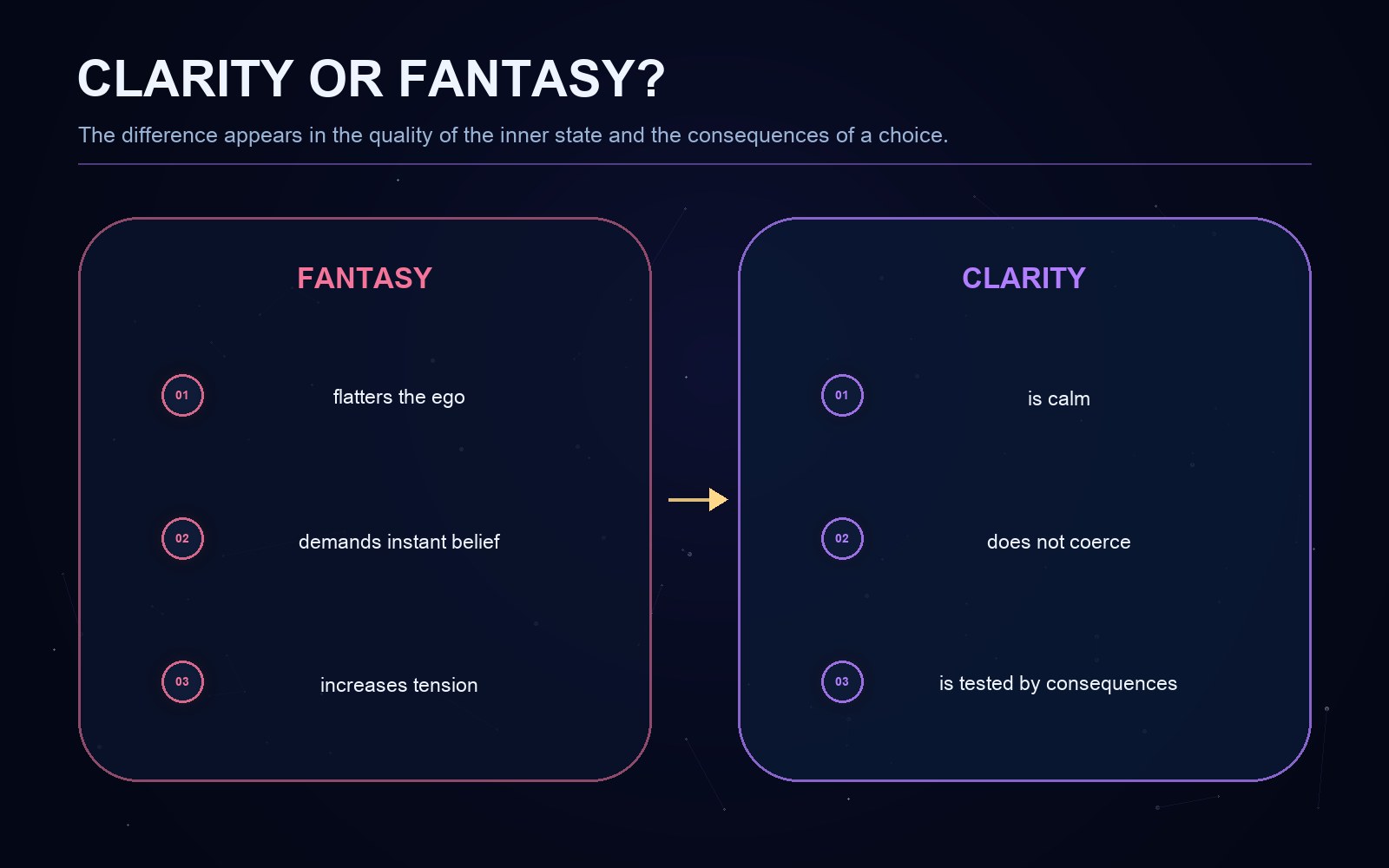
We are capable of mistaking our desires for spiritual guidance. This is especially easy when we are deeply attached to a particular outcome. The mind creates a convenient explanation, gives it an elevated meaning, and calls it the voice of the soul.
Inner perception therefore requires honesty.
A genuine connection with the Higher Self does not flatter us. It does not tell us that we are better than others, chosen for a special mission, or exempt from responsibility. It does not strengthen a craving for admiration, power, or recognition. On the contrary, a wider understanding reveals the consequences of our decisions and asks us to take an adult responsibility for our lives.
I recognize several signs of this influence.
First, it arrives quietly. Even when the decision is difficult, there is no hysterical internal pressure. Fear may still exist at the level of the human personality, but beneath it there remains a clear direction.
Second, it expands perception. We begin to see not only our own advantage but also the effect our choice will have on other people.
Third, it does not cancel freedom. The Higher Self does not compel. It may reveal a direction, but the decision and responsibility remain ours.
Fourth, deeper understanding remains consistent. Emotional impulses change quickly: something feels right today and completely wrong tomorrow. Inner clarity may deepen, but its foundation does not disappear with a change in mood.
Fifth, this connection leads toward creation. I associate the nature of the Higher Self with love—not sentimental emotion, but the principle of unity, respect, and the development of life. Anything that demands the humiliation of others, feeds hatred, or destroys for the sake of self-importance does not arise from this level of consciousness.
One vivid thought is not enough to declare that we have received a message from the Higher Self. Inner understanding must be tested through time, action, and consequences. The more honestly we observe ourselves, the more precisely we can distinguish the voice of fear from the knowledge of the soul.
What a Connection with the Higher Self Gives Us
Above all, it restores awareness.
We begin to understand that we are not accidental biological organisms temporarily appearing between birth and death. Physical life becomes part of a much larger path. The body, social role, and present biography are no longer the final boundaries of our existence.
This changes our relationship with fear. A person who believes they are only a body can easily be controlled through the threat of loss, rejection, and death. When a person begins to recognize themselves as a soul, external authority no longer owns their entire reality. It may affect circumstances, but it can no longer define the meaning of their existence.
The connection with the Higher Self provides inner strength during trials. It does not promise a life without difficulty. On the contrary, many circumstances may be part of the experience for which the incarnation took place. Yet we stop interpreting every obstacle as proof that life is meaningless. We begin to ask: What is this situation revealing within me? What is it teaching me? What choice is it making possible?
We gain the ability to sense the direction of our lives. It does not always appear as a detailed plan. The Higher Self does not hand us a schedule for the coming years. It helps us recognize choices that correspond with the soul’s path and feel when we are moving away from it.
The greatest benefit is not supernatural advice but the restoration of authority over our own lives. An aware person acts less automatically. They notice when fear, resentment, the need for approval, or imposed goals are controlling them. They regain the ability to choose.
The Two Natures Within Us
Physical and spiritual natures are both present within us.
Our physical nature is connected with the body, brain, instincts, and human personality. It helps us survive, build relationships, learn, work, and navigate the material world. There is nothing inferior or wrong about it. Incarnation would be impossible without the body and mind.
Our spiritual nature is expressed through the incarnated aspect of the soul and its connection with the Higher Self. It perceives life on a wider scale and reminds us that our existence is not limited to satisfying physical needs.
These two natures do not have to be at war. The problem begins when the human personality declares itself to be the whole of reality and stops listening to the soul. Fear becomes our primary adviser, thoughts fill the entire inner space, and external circumstances completely determine our state.
The Higher Self does not try to break the personality. Its influence is gentle. It invites us to widen our perception and allow our spiritual nature to participate in earthly life. The clearer this connection becomes, the calmer the mind, the more precise our decisions, and the less inner chaos we experience.
How to Strengthen the Connection
We cannot create a connection with the Higher Self because it has never disappeared. But we can develop our ability to perceive it.
The first step is inner silence. While the mind continuously comments on everything that happens, deeper understanding is difficult to notice. Meditation helps us not to destroy thought but to stop following every thought automatically. Space appears between impulse and reaction, and within that space we begin to perceive ourselves differently.
The second step is a calm threshold state. During deep meditation or trance, attention is partially released from the ordinary work of the senses. The brain no longer occupies the entire field of perception, and the connection with the soul can be felt more clearly. This is why practices involving altered states of consciousness can open access to a wider understanding.
The third step is a precise inner question. We do not need to ask dozens of questions at once and demand immediate answers. It is better to choose one, formulate it honestly, and remain in silence for a time. The response may not arrive in words. Sometimes it appears later as understanding, a change in perspective, or a clear decision.
The fourth step is to test it through life. If inner guidance is truly connected with the greater soul, acting on it will increase integrity, responsibility, and clarity. If a decision produces only self-deception, dependency, and the destruction of relationships, we need to examine our motives again.
The fifth step is consistency. The channel of perception resembles an ability that grows stronger through use. If we turn toward inner silence only during a catastrophe, it is difficult to distinguish deep knowledge from panic. Regular practice establishes an inner point of reference.
Some people use regression hypnosis to enter a trance and approach the memory of the soul. This method can become part of an exploration, but no intermediary can replace our own awareness. The essential work still takes place within us.
Why Difficulty Sometimes Awakens Us
Most people do not begin asking the deepest questions when everything is familiar and comfortable. It usually happens during loss, crisis, illness, disappointment, or an inner turning point.
Difficulty breaks the old picture of reality. Familiar explanations stop working, and for the first time we seriously ask: Who am I? Why am I here? Where did I come from, and what will remain after death?
Suffering alone does not make anyone aware. It can make a person bitter and closed. But it creates a break in the habitual noise. Through that opening, we may hear what everyday concerns had previously drowned out.
The Higher Self does not send punishment. It helps us use every experience for the development of consciousness. Even in difficult circumstances, we remain free to choose who we become in response to what has happened.
The Higher Self and Human Freedom
The stronger our connection with the soul, the less we need external permission to be ourselves.
We remain capable of listening to others, learning, and changing our minds, but we no longer hand them the authority to define our inner reality. We notice manipulation through fear, refuse to mistake popularity for truth, and stop obeying simply because the majority has accepted a convenient version of the world.
This is why awakening is always connected with responsibility. We cannot seek inner freedom while shifting the consequences of our decisions onto society, fate, a spiritual teacher, or the Higher Self. A wider consciousness will not live our lives in our place.
The Higher Self offers direction, energy, and understanding. We turn them into action.
A genuine spiritual connection does not make us passive. It restores our ability to act without constant fear, defend human dignity, create something new, and build relationships based on love rather than dependency.
We Are Already Connected
The Higher Self is not somewhere far away in the universe. We do not have to wait for a special sign, earn its attention, or become perfect. The greater soul is already present in our lives through an unbreakable inner connection.
Our task is not to invent that connection but to remove what prevents us from perceiving it: the constant noise of thought, fear, self-deception, other people’s expectations, and the habit of treating the physical personality as the only form of our existence.
Every step toward awareness widens this channel. Every honest observation makes our inner perception more precise. Every decision made from clarity strengthens the soul’s ability to express itself in earthly life.
When we begin to hear the soul, we do not become someone else. For the first time, we begin to become who we truly are.
In my book The Phenomenon of Consciousness Beyond the Body, I explore my model of consciousness, the energetic levels of reality, the nature of the soul, meditation, and the practice of out-of-body experience in greater depth.
Leave a Reply