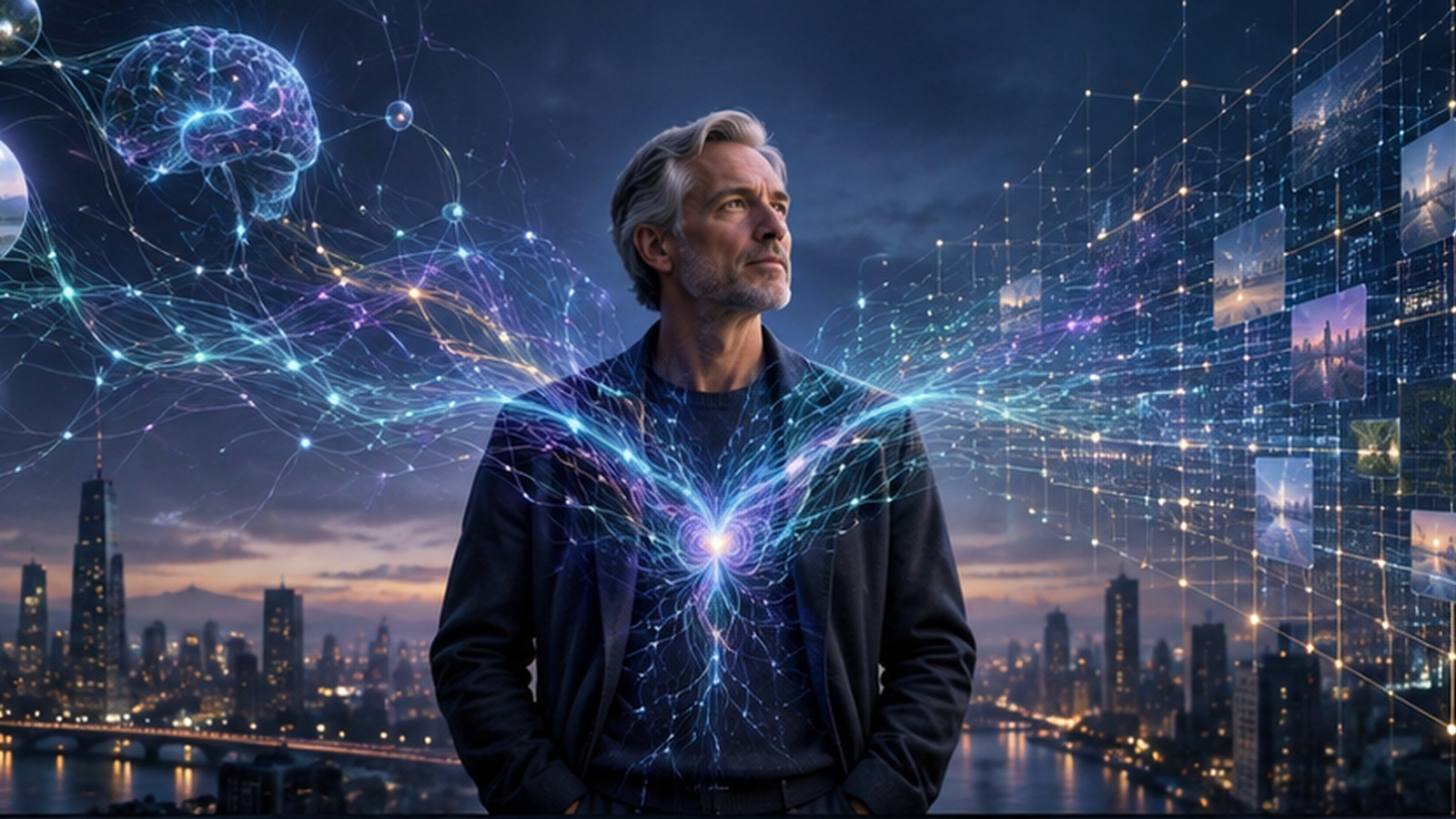
Humanity is entering an era in which technology reaches ever more deeply into not only our work and daily lives, but also our attention, memory, decisions, and understanding of ourselves. Machines already help us see farther, calculate faster, and reach an enormous body of knowledge. The next step is the rise of systems capable of proposing solutions before a person has even formulated the question.
I see both an extraordinary opportunity and a serious danger in this development. Technology can expand human ability. It can also gradually train us not to think, not to choose, and not to take responsibility for our own lives.
Technology Does Not Choose Its Own Direction
A hammer can build a home or become a weapon. Artificial intelligence can help a physician recognize a pattern, help a researcher process data, or help a student understand a difficult subject. The same system can manipulate attention, displace independent thought, and turn a person into a predictable consumer.
The machine does not set the direction. Direction comes from the level of awareness of the people who create the technology, fund its development, establish the rules, and decide how it will be used.
The future therefore cannot be reduced to processor speed. The central question is who will wield this power, and for what purpose.
Expanded Ability Begins with Freedom
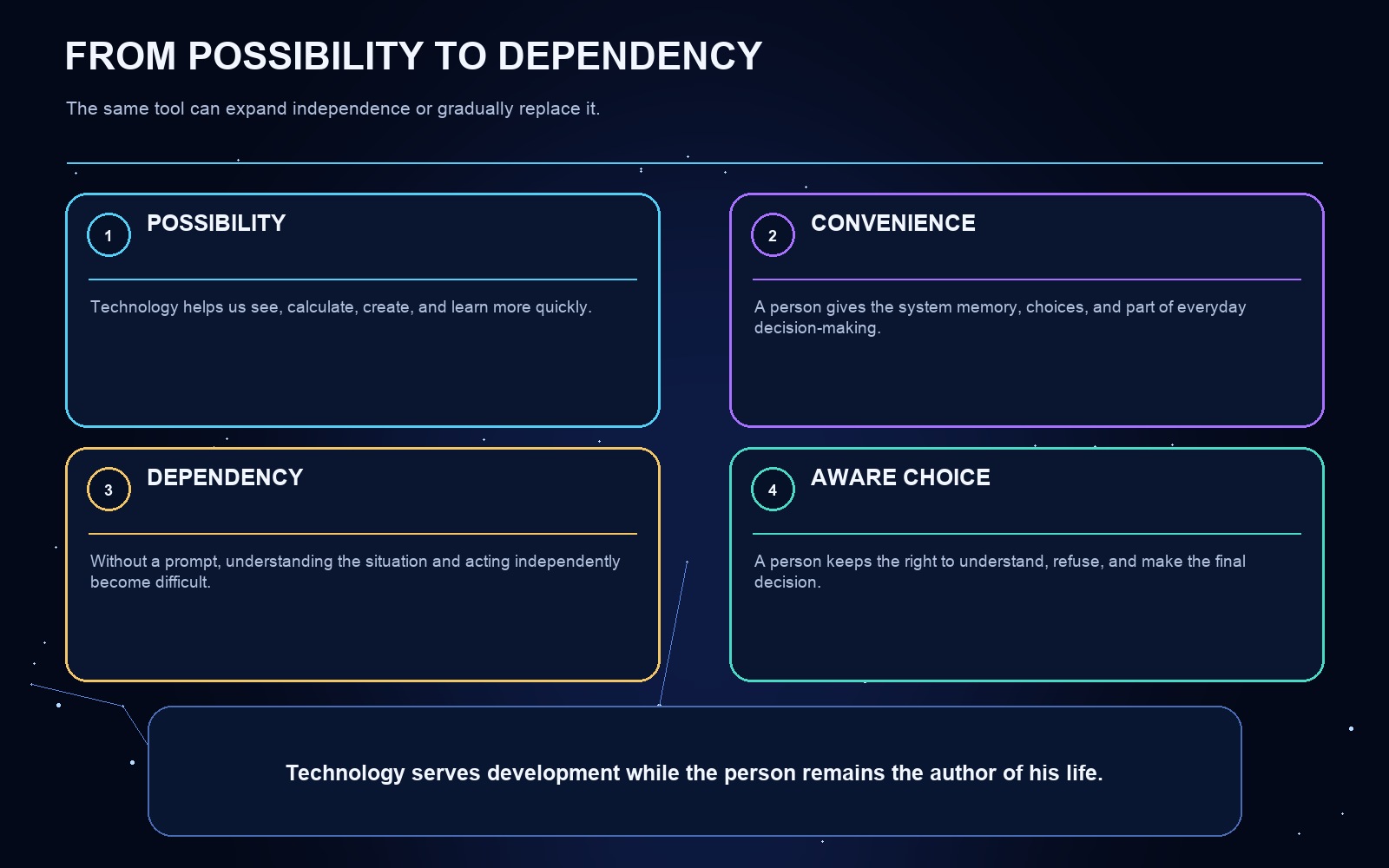
Technology genuinely expands a person when it helps us do what was previously impossible while preserving our right to understand what is happening and make the final decision.
A useful system explains the basis for its recommendation. It allows refusal. It does not punish disagreement. It helps a person learn instead of making learning unnecessary. It frees time for creativity, relationships, investigation, and inner growth.
When convenience is purchased with constant surveillance, hidden influence, and the loss of independence, we are no longer expanding human ability. We are exchanging freedom for comfort.
Dependency Develops Quietly
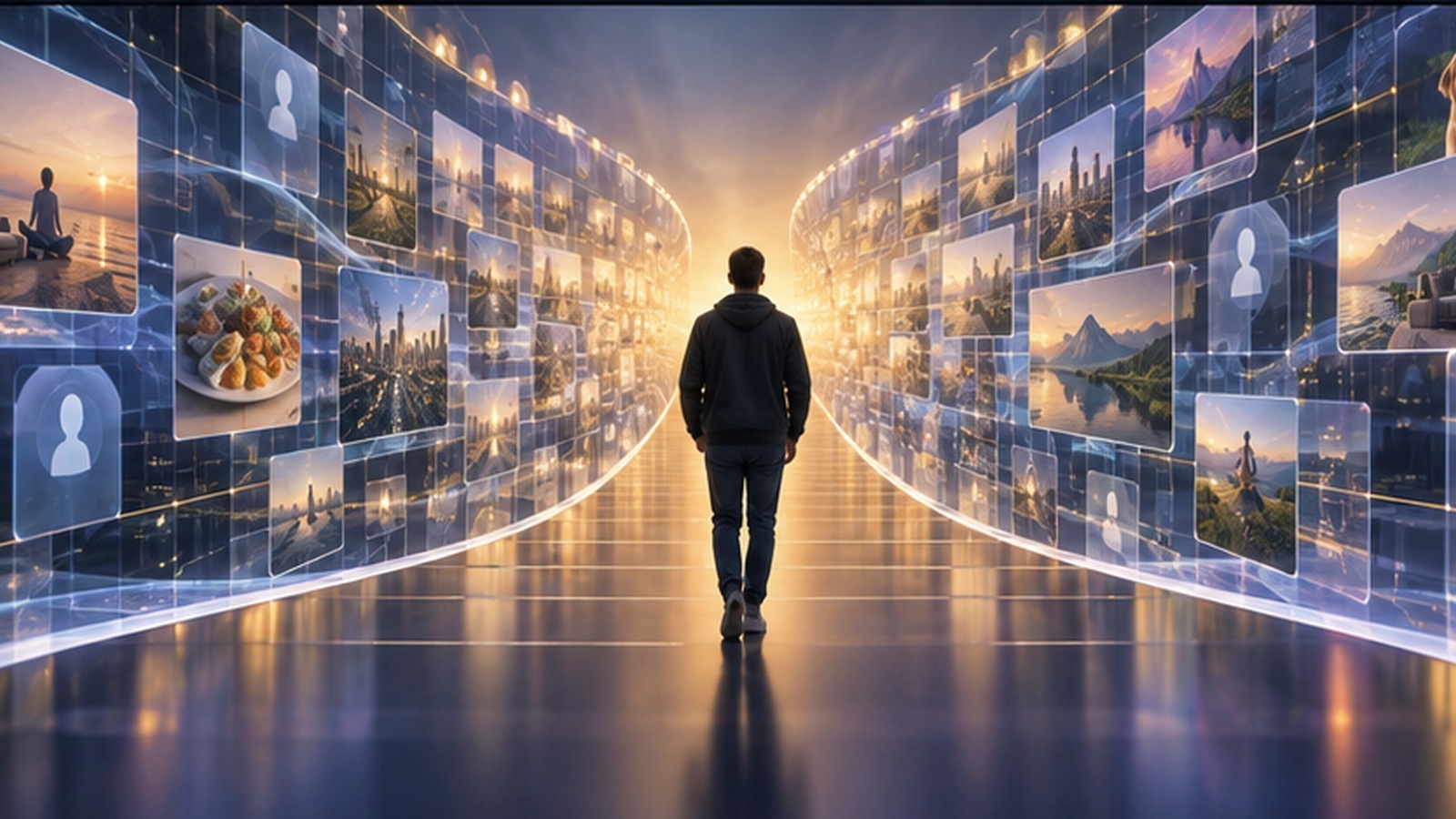
Dangerous dependency rarely begins with force. At first, a technology merely saves us a few minutes. Then we hand it our schedule, our memory, our route, our information, our judgments about other people, and the formation of our opinions. After a while, a person no longer understands why he made a particular choice: because he truly wanted it, or because the system placed that option in front of him.
We most easily surrender the work that requires inner effort: patience, fact-checking, questioning a first impression, and accepting responsibility for a mistake.
This creates a new kind of autopilot. Outwardly, a person is surrounded by limitless possibilities, while his real field of choice narrows to the options selected in advance by an algorithm.
The Brain, Consciousness, and the Digital Intermediary
In my book, I describe the brain as a highly complex biological interface through which the consciousness of the soul interacts with the body and physical reality. The brain processes signals, constructs models, activates habitual reactions, and helps the personality function in the material world. But I do not reduce the source of the inner self to the activity of the nervous system.
Digital technology adds another layer between consciousness and the world. This layer can strengthen our abilities, but it can also shape our picture of reality before we have had the opportunity to see it for ourselves.
The more powerful the intermediary becomes, the more important it is to preserve contact with our own observation, conscience, and Higher Self. Otherwise, a person may begin to mistake the system's suggestion for his own inner voice.
Control of Attention Becomes a Form of Power
Power was once associated mainly with territory, armies, and money. Today, enormous power belongs to whoever can direct the attention of millions.
If a system determines which events we see, which opinions appear popular, what we fear, and whose lives we compare with our own, it can influence behavior without issuing a direct command. A person remains convinced that he is acting freely even though the information underlying his decision was carefully selected.
This form of influence does not require a single secret center. An economic model that profits from holding attention, intensifying emotion, and producing predictable user behavior is enough.
Technocracy Begins When a Person Becomes a Metric
Technocratic thinking tries to measure everything. Measurement is useful as long as it helps us see reality more clearly. The problem begins when anything that cannot be quickly expressed as a number is declared irrelevant.
Conscience, dignity, love, inner freedom, and meaning do not fit neatly into a spreadsheet. Yet they determine why progress should exist at all.
Once a person becomes a collection of data points, he is easy to evaluate, rank, and direct. A system can estimate the probability of a purchase, an illness, a protest, or a resignation, but it does not see a living soul. It knows behavior; it does not know inner experience.
Awareness Protects Us from Disappearing into the System
An aware person does not reject technology. He uses it while also observing how it changes his attention and behavior.
He asks simple questions:
- Who is offering me this decision?
- What data was used?
- Whose interests does this path serve?
- Can I refuse?
- What ability will I lose if I surrender this function completely to a machine?
- Does this tool leave me stronger and more independent?
Questions like these restore authorship of one's own life.
What Human-Centered Technological Progress Should Look Like
I consider a technology progressive when it:
- expands access to knowledge instead of replacing knowledge with a ready-made answer;
- helps a person make decisions while preserving the right to make mistakes and disagree;
- protects personal data and inner freedom;
- makes its methods of influence understandable;
- frees time for development instead of filling it with a new stream of stimulation;
- is judged not only by profit, but by its consequences for the individual and society.
Technical power must be accompanied by moral and spiritual maturity. Otherwise, every new instrument merely increases the reach of old human weaknesses.
The Future Is Not Determined by Machines
I am not afraid of technology, and I do not call for a return to the past. I see it as a means of exploring the Universe, advancing health and education, and strengthening human connection. But a tool must not become the master.
A technocratic future will not arrive when machines become too intelligent. It will arrive when people agree to abandon their inner work and give an external system the right to define truth, success, and the meaning of life.
When a person preserves awareness, technology becomes an extension of his creative power. When he lives on autopilot, it becomes an extension of someone else's will.
The choice between these directions is already being made—in every moment when we decide to think for ourselves or simply press the button placed before us.
In The Phenomenon of Consciousness Beyond the Body, I explore the nature of consciousness, the role of the brain, and the development of awareness in greater depth.
Leave a Reply