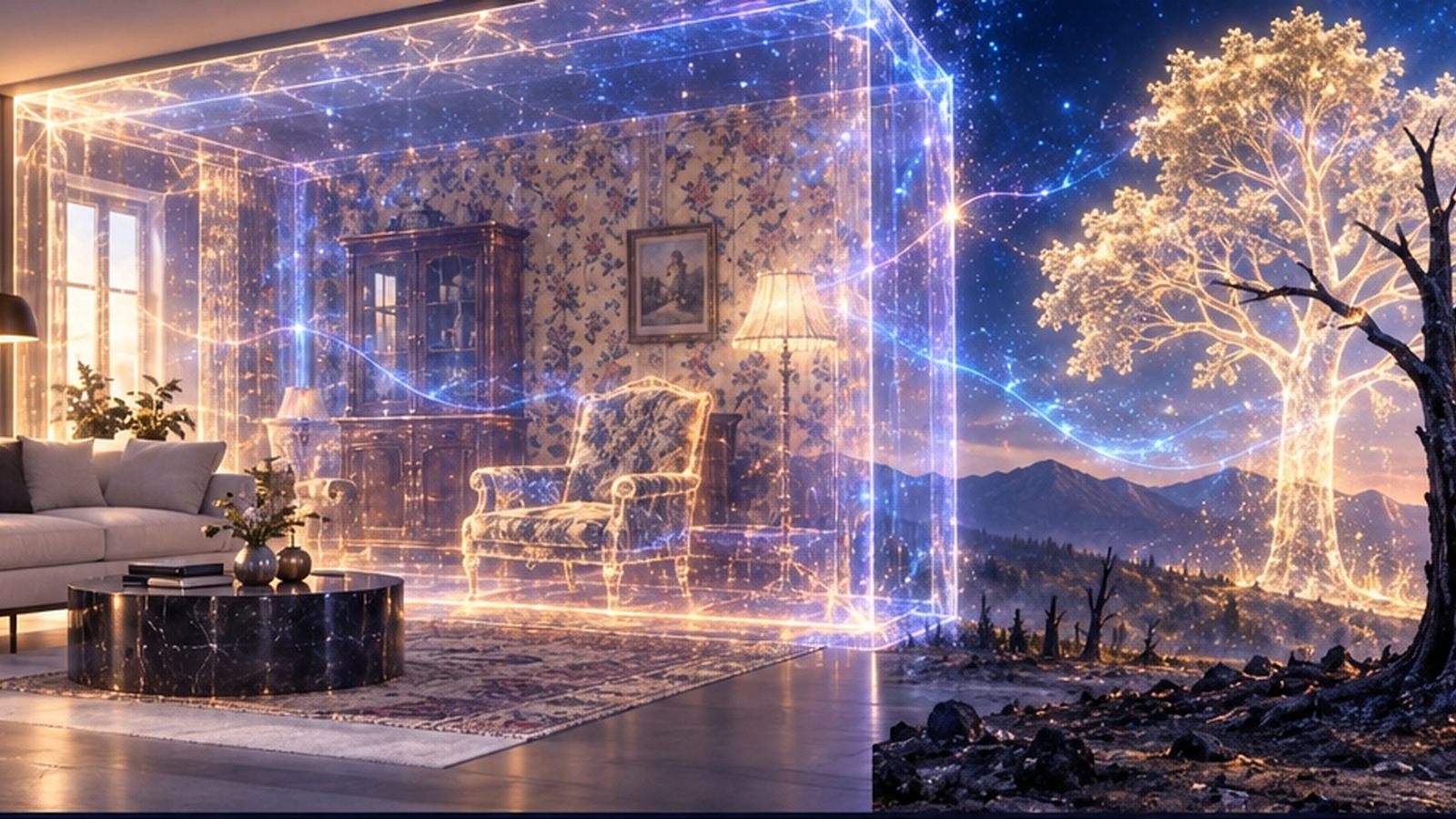
On the second energy level, a familiar place sometimes appears as it did in the past. Old wallpaper remains in a room. A demolished building may still stand in its former shape. After a forest fire, the energetic reflection of the trees may continue to exist.
I call this the energetic trace of matter. It helps explain why the nonphysical reflection of the world does not change at the same moment as the physical world.
Matter leaves a subtler echo
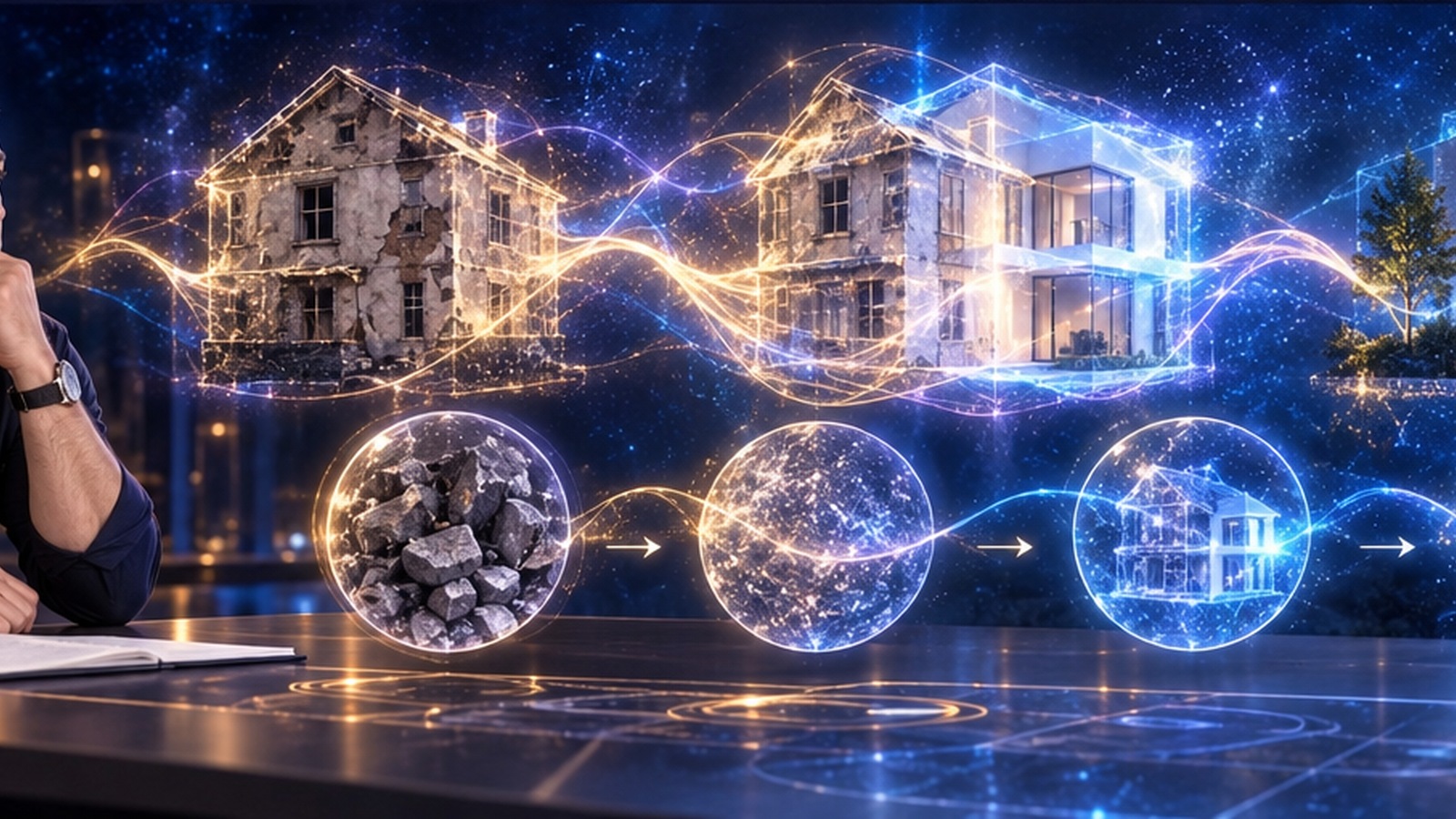
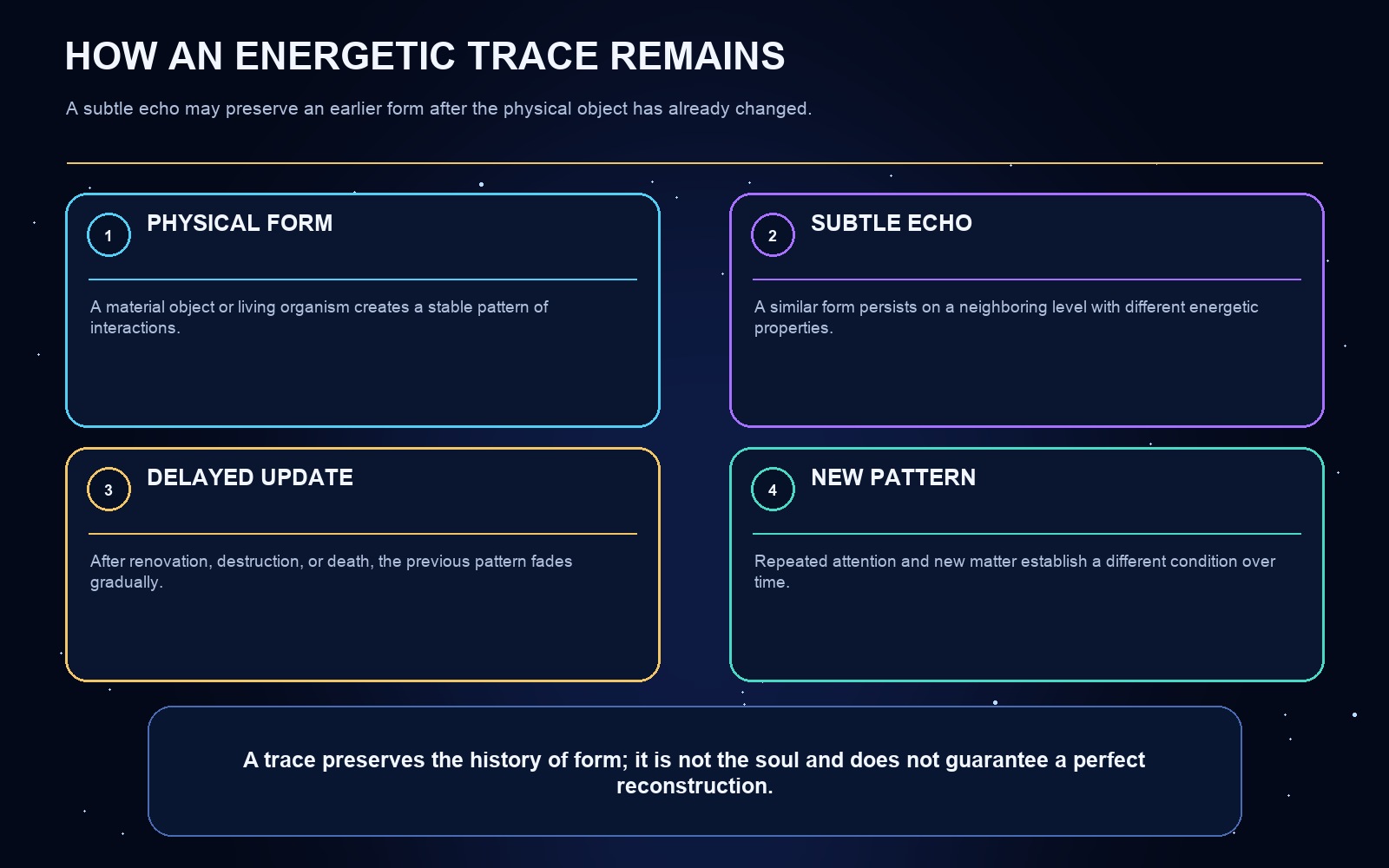
My observation is that physical matter is connected with a less dense energetic structure. An object exists here while also leaving a form on the nearest energy level.
This is neither a photograph nor an exact copy of every atom. The energetic echo preserves an overall structure, properties, and a history of interaction with the surrounding space.
When a physical object changes or disappears, its trace may remain longer.
Why old wallpaper remains on the wall
During one of my earliest experiences, I saw wallpaper of another color in a room. It did not match the wall's current physical condition, but it appeared solid and real.
Such a difference can be explained through mental memory. Repeated observations, however, show that the environment sometimes preserves an earlier form independently of a person's expectation.
The energetic reflection does not update instantly. A new physical state must gradually form a stable trace of its own.
Living beings leave a distinctive imprint
After a tree dies, its form and emotional quality may remain on the second level. In a burned forest, I perceived distress connected with the ending of plant life.
This does not mean that a tree thinks in human words. A living system possesses its own level of consciousness and responds to destruction differently from a stone or a wall.
The energetic trace of a living being may therefore contain not only outward form, but also a condition.
Events and people also create traces
Places marked by prolonged fear, violence, prayer, or intense joy sometimes feel different. Repeated emotions from many people form a stable structure that outlives an individual event.
This is how the atmosphere of a place develops. Human memory and expectation create part of it. Yet not every impression can be reduced to prior knowledge, especially when the investigator knows nothing about the location's history.
This makes verification possible: first the impression is recorded, and only then is the history of the place examined.
An energetic trace is not a soul
The imprint of a personality should not be confused with the independent consciousness of a deceased person.
An image, movement, or emotional scene may repeat in a room. If it does not respond to the observer and plays out the same way each time, it resembles a recording rather than a living contact.
An independent soul can change behavior, answer, and express an intention of its own. An energetic trace repeats a preserved structure.
Why the trace disappears
Over time, the new condition of a space becomes stronger than the old one. New objects, events, people, and living systems form another energetic pattern.
A trace weakens when nothing continues to support it. The exact rate depends on the strength of the event, the time the object existed, and the properties of the place.
In the physical world, we see the destruction of form. On an energy level, that process may continue much longer.
Can a trace be used as a historical archive?
In principle, yes. If we learn to distinguish a stable imprint from our own imagination, we may be able to obtain information about a place's past.
There are many sources of error. Prior knowledge creates expectation. Strong emotion produces a mental scene. One image can easily be mistaken for a precise reconstruction.
The investigation should therefore be blind: the practitioner does not know the location's history, records the details before receiving information, and has an independent person conduct the comparison.
How to distinguish a trace from the investigator's knowledge
For a test, choose a place whose history the practitioner does not know. Another person records the control information before the experience but does not reveal it. The investigator documents architecture, the condition of objects, recurring actions, and emotional atmosphere before any discussion.
After several attempts, both matches and consistent errors are compared. If an unfamiliar detail recurs and is later confirmed by documents or physical investigation, the hypothesis of an energetic archive becomes stronger. If the images change with expectation, a mental construction is more likely.
Energy preserves the history of form
Physical destruction does not always mean the instantaneous disappearance of every level of an object. Matter leaves a trace that continues to exist and gradually changes.
For me, this is one of the keys to understanding the second energy level. It explains discrepancies in familiar places, many accounts of recurring images, and the possibility of investigating the past without a physical time machine.
Every individual case still requires verification. The energetic archive exists alongside human mental creativity, and an investigator must learn to distinguish between them.
In The Phenomenon of Consciousness Beyond the Body, I describe the energetic reflection of physical reality, the old wallpaper, and the trace of the burned forest.
Leave a Reply