
Children often ask questions that adults stopped noticing long ago. Who am I? Where was I before I was born? Why do people die? Why can I fly in a dream? They have not yet learned to divide reality into approved and forbidden subjects.
I believe that early in life, the connection between personality and soul is expressed more freely. That does not mean every childhood fantasy should be declared a past-life memory or an out-of-body experience.
The child has not yet built a rigid filter
Over many years, an adult brain learns to select only the information that fits an accepted picture of the world. Anything unusual quickly receives a familiar explanation or is discarded.
In a child, this filter is still forming. Children more easily notice inner images, subtle emotional changes, and states between sleep and waking. Sometimes they speak about events or people they could not, in the adults' view, possibly remember.
Such accounts deserve attention, but not a predetermined conclusion.
Imagination is not the enemy of awareness
A child's imagination actively creates worlds, characters, and stories. This is a normal ability of the brain, not proof of spiritual contact.
Adults tend to make one of two mistakes. Some immediately ridicule the child and teach him not to trust his own perception. Others turn every story into a sensation and impose their own explanation.
Both responses deprive the child of the opportunity to understand the experience independently.
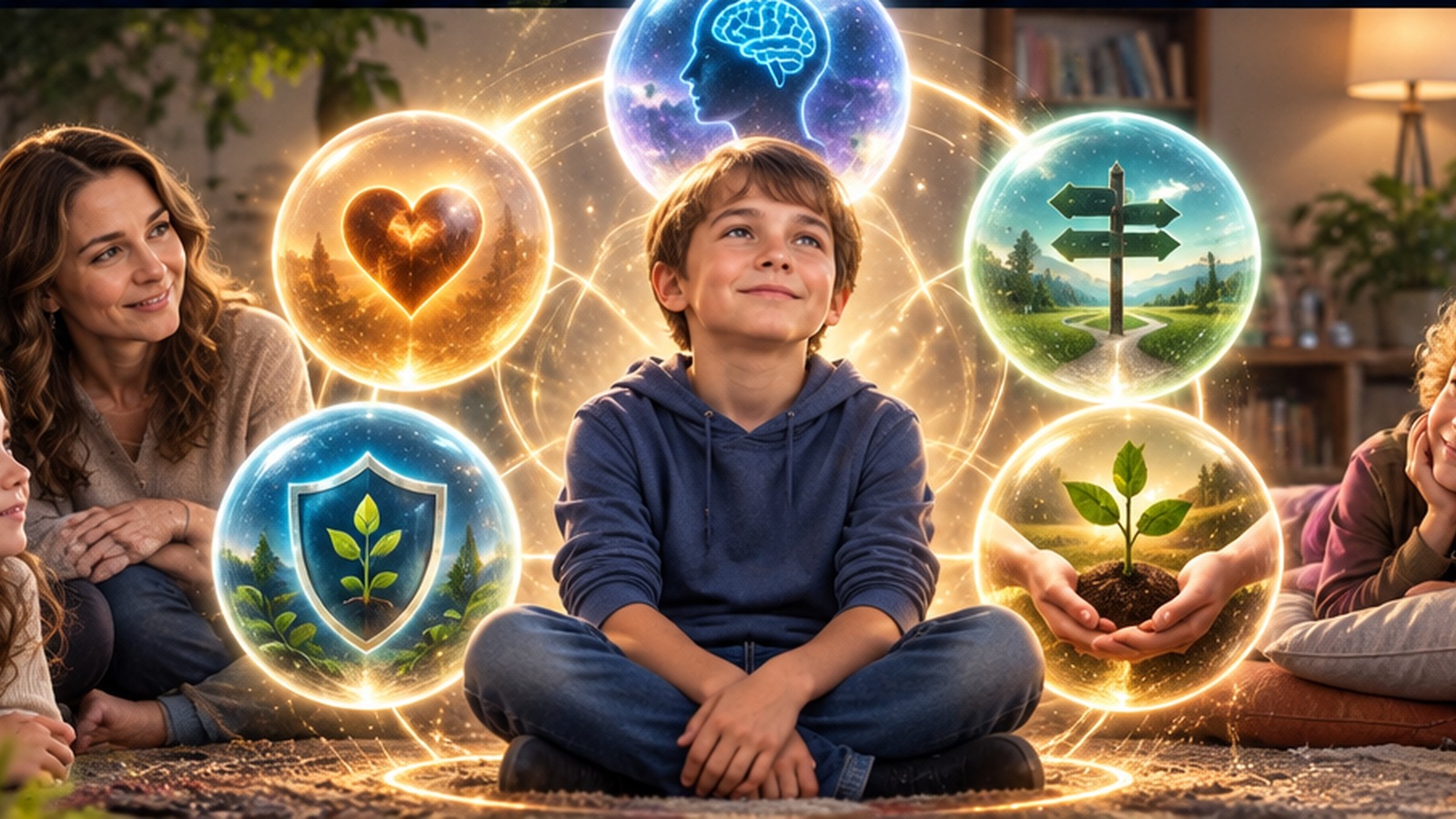
Awareness does not begin with mysticism
For a child, awareness begins with the ability to notice:
- what he is feeling right now;
- why a particular thought arose;
- how an action affects another person;
- where his personal boundary lies;
- when fear, resentment, or group pressure is directing him.
These abilities matter more than conversations about energy levels. They create an inner foundation that will later help the child investigate difficult questions independently.
The responsibility of parents
Awareness cannot be measured by beautiful words. It is expressed in the ability to think about consequences.
Bringing a child into the world means accepting responsibility for safety, education, emotional development, and the opportunity to become an independent person. It is not enough to demand obedience. We must explain reasons, respect questions, and lead through our own actions.
A child quickly notices the contradiction between an adult's words and actual behavior.
Do not turn a child into a spiritual project
Some parents want to see an “old soul,” a medium, or a future spiritual leader in their child. Such expectations are dangerous. The child begins to perform a role that brings attention and gradually loses the ability to distinguish personal experience from the adults' wishes.
Children should not be pushed to practice leaving the body, contact unknown beings, or prove unusual abilities. Their nervous systems and personalities are still developing.
The central task is to provide safety, freedom to ask questions, and the right not to fulfill someone else's expectations.
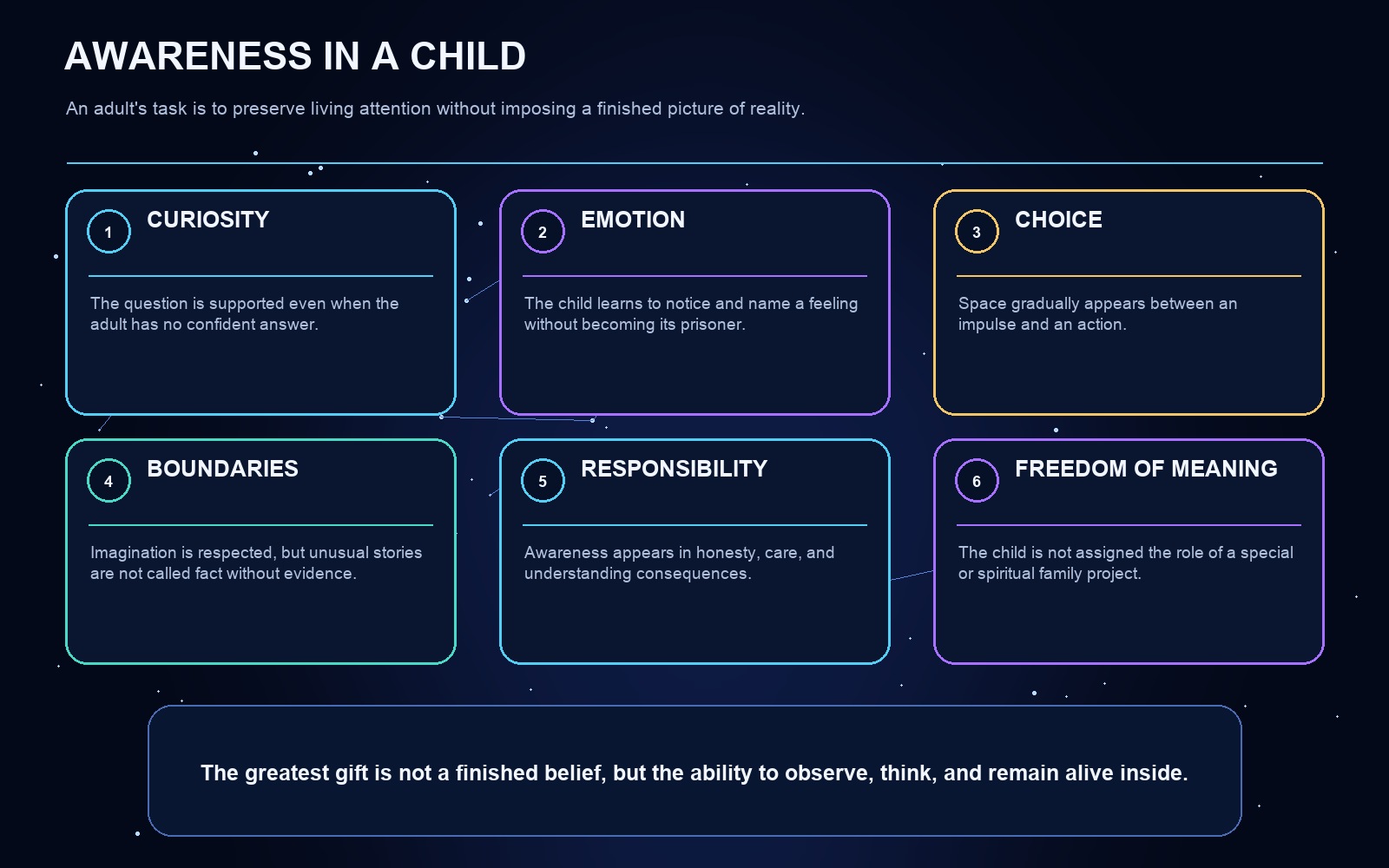
How to discuss unusual experiences
If a child describes a strange dream, encounter, or memory, first listen without supplying an explanation. Open questions are helpful: “What did you see?” “How did you feel?” “What happened next?”
Questions such as “Was it an angel?” or “Did you see a past life?” should be avoided. The answer is already embedded in them, and that can change the story.
The child's exact words can be recorded and revisited later. Specific information can sometimes be checked. When it cannot, the account remains part of the child's inner experience and still deserves respect.
What children gradually lose
As people grow, they learn to meet expectations. They suppress curiosity, fear looking foolish, and replace living questions with ready-made opinions.
What is lost is not necessarily a mystical ability. More often, it is honesty of perception: the ability to say “I don't know,” notice a feeling, and recognize an obvious contradiction.
Conscious parenting should help preserve that honesty.
Awareness is visible in behavior
A child's unusual stories may be interesting, but I do not consider them the principal sign of development. Awareness appears in simpler ways: Can the child notice a feeling, hear another person, admit a mistake, and choose an action that avoids unnecessary harm?
If adults admire only mystical stories, the child quickly learns what kind of account makes him special. Living investigation then turns into a role. It is far more important to support honesty: a child should be able to describe an experience without fear of ridicule while learning to distinguish fantasy, dream, memory, and an event in the external world.
What adults can learn from children
A child's view reminds us that reality does not have to fit within our system of concepts. A child may observe for a long time what an adult passes without noticing.
Mature awareness combines a child's openness with an adult's responsibility. It neither accepts everything on faith nor closes the door in advance.
I want children to grow not into obedient carriers of other people's beliefs, but into independent human beings capable of feeling, thinking, testing, and making their own choices.
In The Phenomenon of Consciousness Beyond the Body, I explain how the earthly personality forms and why its connection with the soul's wider consciousness may weaken as a person grows.
Leave a Reply