
On the second energy level, distance does not operate as it does in the physical world. We do not always have to travel mile after mile in sequence. Intention and a clear image of the destination can immediately change the area in which consciousness finds itself.
This creates an extraordinary possibility: searching for a particular place or person. It is also where a desired image can most easily be mistaken for a genuine result.
Intention sets the direction
During an out-of-body experience, thought acts like a coordinate. If I hold a familiar place clearly in mind, the transition can happen almost instantly. I do not fly across the physical distance; I find myself in another region of perception.
Destinations connected with stable memories and strong recognition work best. This is why I often found myself automatically in the yard where I grew up. That place is deeply established in my memory.
Familiarity also creates a problem: the brain is capable of completing the expected scene on its own.
Finding an image is easier than finding the physical object
If a person imagines a friend's house, he will almost certainly see some kind of house. That does not prove that he reached the actual reflection of the intended location.
He may have arrived at:
- an energetic reflection of the physical space;
- an altered version of the familiar place;
- a mental construction created by memory;
- an independent realm that only resembles the destination.
The question “Did I get there?” cannot be settled by confidence alone.

Finding a person is harder than finding an address
A person is not a fixed point. The physical body may be in one place, attention in another, and consciousness during sleep in a mental environment of its own.
On the second energy level, we may encounter a reflection of the sleeping person, a thought-form, or an independent aspect of consciousness. These forms do not always behave in the same way. A person may answer us there and remember nothing after waking.
The fact of a meeting does not tell us which aspect of the person we contacted.
An emotional bond helps and interferes
A strong bond makes it easier to hold the destination. The image of someone close arises quickly and carries many details.
At the same time, hope, fear, and longing increase the risk of creating the desired meeting. The more important the result, the stricter the test must be.
An emotionally convincing contact cannot be called objective merely because it brought relief.
What an honest test looks like
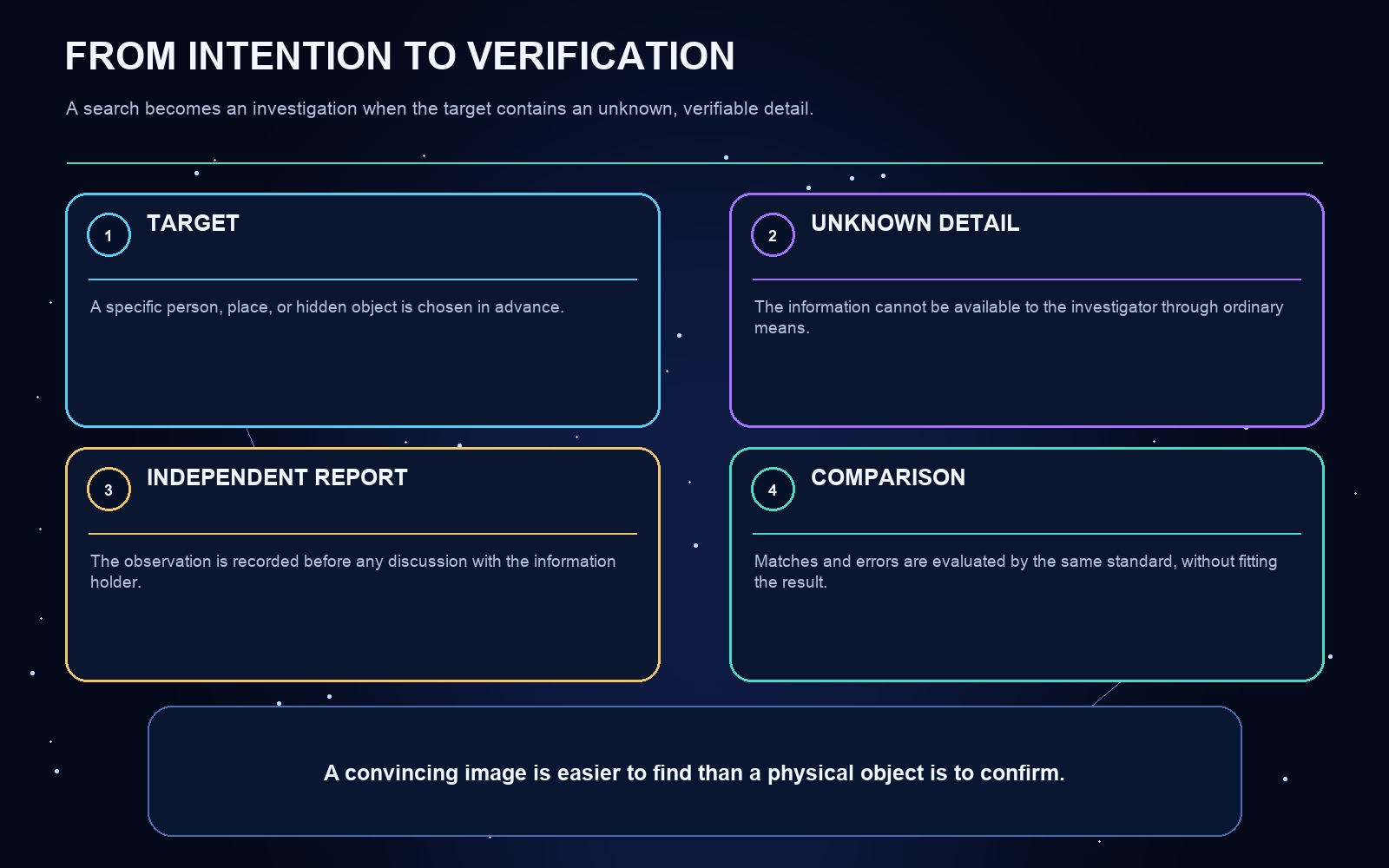
The best method is to prepare information the practitioner does not know. For example, an independent person selects an unusual object or image and places it at the agreed location only after the participant has already received the assignment.
After the experience, the practitioner records everything observed before receiving any hints. Only then is the target revealed and compared with the report.
General similarities such as “something pale” or “a round object” are not enough. Specific and unexpected details matter. One success is interesting; a series of results under the same conditions is far more valuable.
An error also provides information
If the practitioner describes another room or sees an object that is not there, that does not always mean the entire experience was meaningless. Perhaps he reached an energetic reflection of an earlier state of the place. Perhaps a mental construction replaced the target. Perhaps the transition simply failed.
But explanations must never become a way to declare every outcome a success. An error must remain an error until evidence supports another conclusion.
That is how an investigation develops.
The ethical boundary
The ability to search for a person does not give us the right to invade that person's privacy. An intention to observe someone without consent still crosses a boundary, even if the action takes place outside the physical body.
I consider experiments acceptable when participation is voluntary, the task is agreed in advance, and the purpose is clear. Curiosity does not cancel respect.
A series matters more than one match
One precise result can be a major personal event, but it is not enough for research. The conditions should be defined beforehand: who chooses the target, what qualifies as a match, how many attempts will be made, and when the correct answer will be revealed. These rules cannot be changed after the outcome is known.
A repeatable series reveals not only successes, but the pattern of errors. Perhaps accuracy declines under strong emotion, familiar places are found more often, or shapes transfer more reliably than numbers. This material helps us understand the mechanism. An honest protocol does not destroy mystery; it makes the possibility open to study.
The possibility exists; evidence requires discipline
My experience shows that consciousness can move with direction and find familiar regions. I have also seen how easily expectation changes the result.
I therefore do not choose between belief and denial. I choose verification. An unusual ability becomes knowledge only when we can separate real information from memory, coincidence, and mental creativity.
In The Phenomenon of Consciousness Beyond the Body, I describe methods of movement, encounters, and the distinctive properties of the second energy level.
Leave a Reply