
Human beings have always searched for ways to move beyond ordinary perception. Different cultures have used plants, alcohol, and psychoactive substances for this purpose. Today these substances are sometimes presented as a shortcut to spiritual experience.
I do not deny that a person under the influence of a substance may enter an unusual state. But altered perception and the conscious investigation of reality are not the same thing.
An open door is not a guided journey
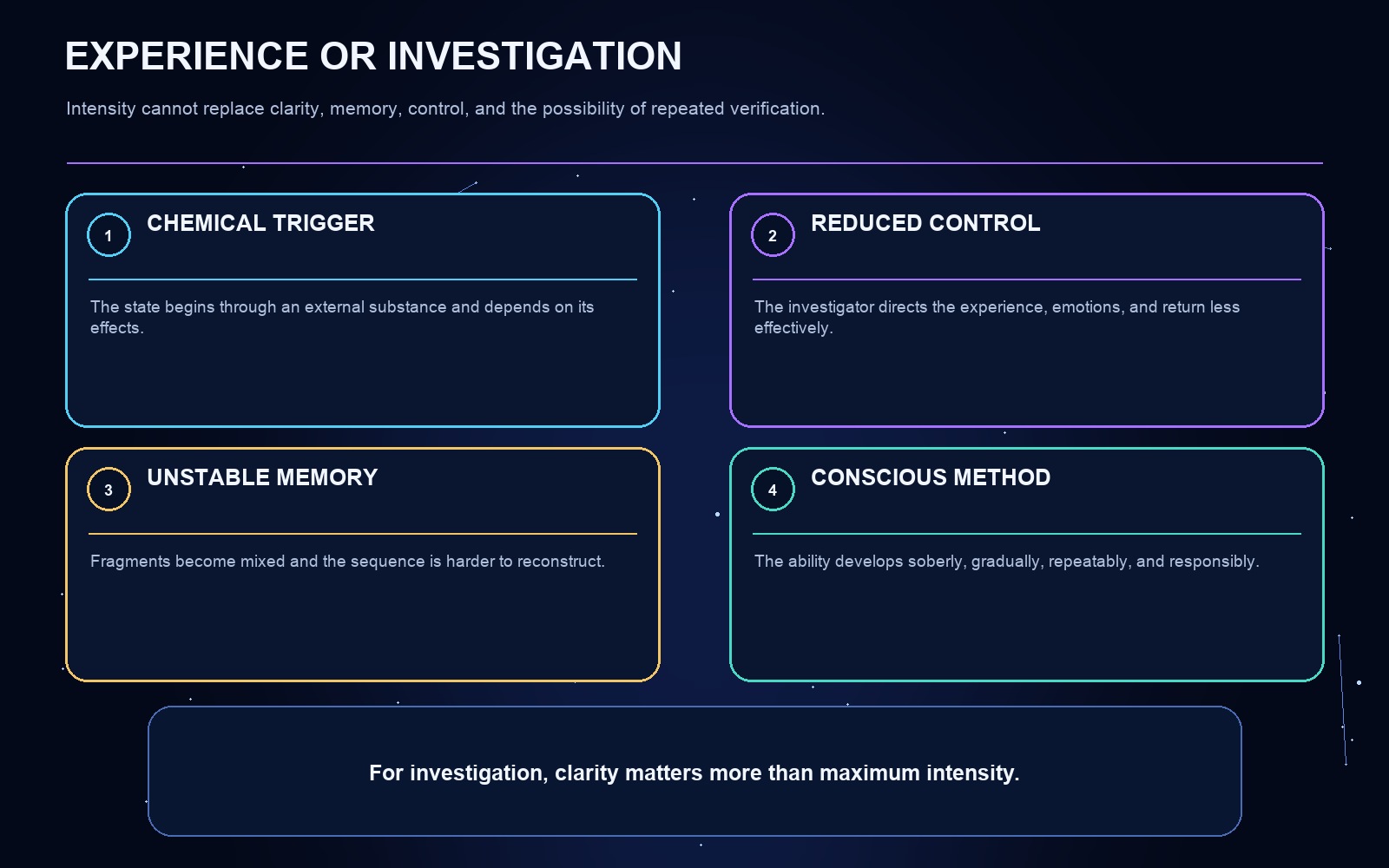
A substance may weaken the brain's familiar operations, change how signals are filtered, and open access to images, emotions, or nonphysical perception. Most often, however, the person does not control the moment of transition, the direction of movement, or the end of the experience.
He becomes a passenger in a process already set in motion by a chemical influence. The intensity may be enormous while the ability to examine what is happening is minimal.
Conscious practice is built differently. The investigator learns to enter an altered state through intention, preserve memory, hold a purpose, and return to an ordinary state without chemical dependence.
The central problem is diminished control
A high-quality out-of-body experience requires clarity, emotional stability, and control of attention. Alcohol and psychoactive substances disrupt precisely these functions.
A person may feel that he has received final knowledge. Yet at that moment, it is especially difficult to separate an independent environment from a mental construction, or an observation from an intensified emotion.
A powerful feeling of truth is not, by itself, a test. The brain can give absolute conviction to an image it generated internally.
Memory becomes unreliable
Even an ordinary out-of-body experience can be difficult to transfer fully into the brain's memory. Details fade quickly after returning unless the person deliberately reconstructs the sequence of events.
Under the influence of a substance, the task becomes harder. Memory may break into fragments, and later interpretation fills the gaps. After several days, the person may remember not the experience itself, but the story he has built around it.
That is a serious problem for any investigation.
A chemical state should not be confused with development
An unusual experience can show a person that familiar reality is not all that exists. But one experience does not automatically change character, habits, or level of awareness.
Someone may see magnificent worlds and remain dependent on fear. Someone may experience unity with the Universe and continue to treat loved ones irresponsibly. Development begins after the vision, in the daily work a person does with himself.
A substance can produce an event. It cannot do the inner work for us.
Dependence on an external key
When access to an unusual state is tied to a substance, a person begins to believe that the door is closed without it. He seeks to repeat the intensity, increases the dose, or lives in anticipation of the next session.
The investigation of consciousness then becomes dependence on a way of altering the brain. The person does not develop command of attention because the chemical key performs the work each time.
I consider a path more valuable when the ability becomes part of the person himself.
The physical organism participates in the experience
We investigate nonphysical states while remaining connected to a living body. The condition of the nervous system, heart, breathing, and brain matters. Substances place a physiological burden on the body and may interact unpredictably with anxiety, illness, and medication.
These risks should not be romanticized with spiritual language. If a method damages health or takes away control, its cost is too high.
What a conscious path looks like
Conscious practice is built on sobriety, gradual development, and the ability to repeat an experience without an external chemical influence. A person learns to:
- hold a clear intention;
- notice the transition between states;
- direct attention;
- distinguish emotion from observation;
- restore memory after returning;
- test the information received.
These abilities remain with the person and influence ordinary life.
Integration matters more than intensity
After an unusual state, a person may want to preserve the feeling of expansion at any cost. But the value of an experience is not measured by the strength of the impression. It becomes visible in whether the person is more attentive to loved ones, more honest in decisions, and freer from automatic reactions. If another external influence is required simply to feel meaning again, the experience has not been integrated into life.
Sober practice gives us time to examine what happened, compare it with earlier observations, and see its consequences. Between experiences there is ordinary life, where everything received is tested. That interval turns a powerful event into understanding, and understanding into a stable human quality.
I choose clarity
I do not condemn people for their search, and I do not deny the significance of their experiences. For myself and for my work as an investigator, however, I choose a path without substances.
It is not enough for me simply to see something unusual. I need to understand where I am, why I perceive it in this particular way, whether I can change direction, and what remains valid when tested.
Freedom of consciousness is expressed not in the loss of control, but in the ability to expand perception while remaining aware.
I discuss the effects of alcohol and psychoactive substances on out-of-body practice in The Phenomenon of Consciousness Beyond the Body.
Leave a Reply