
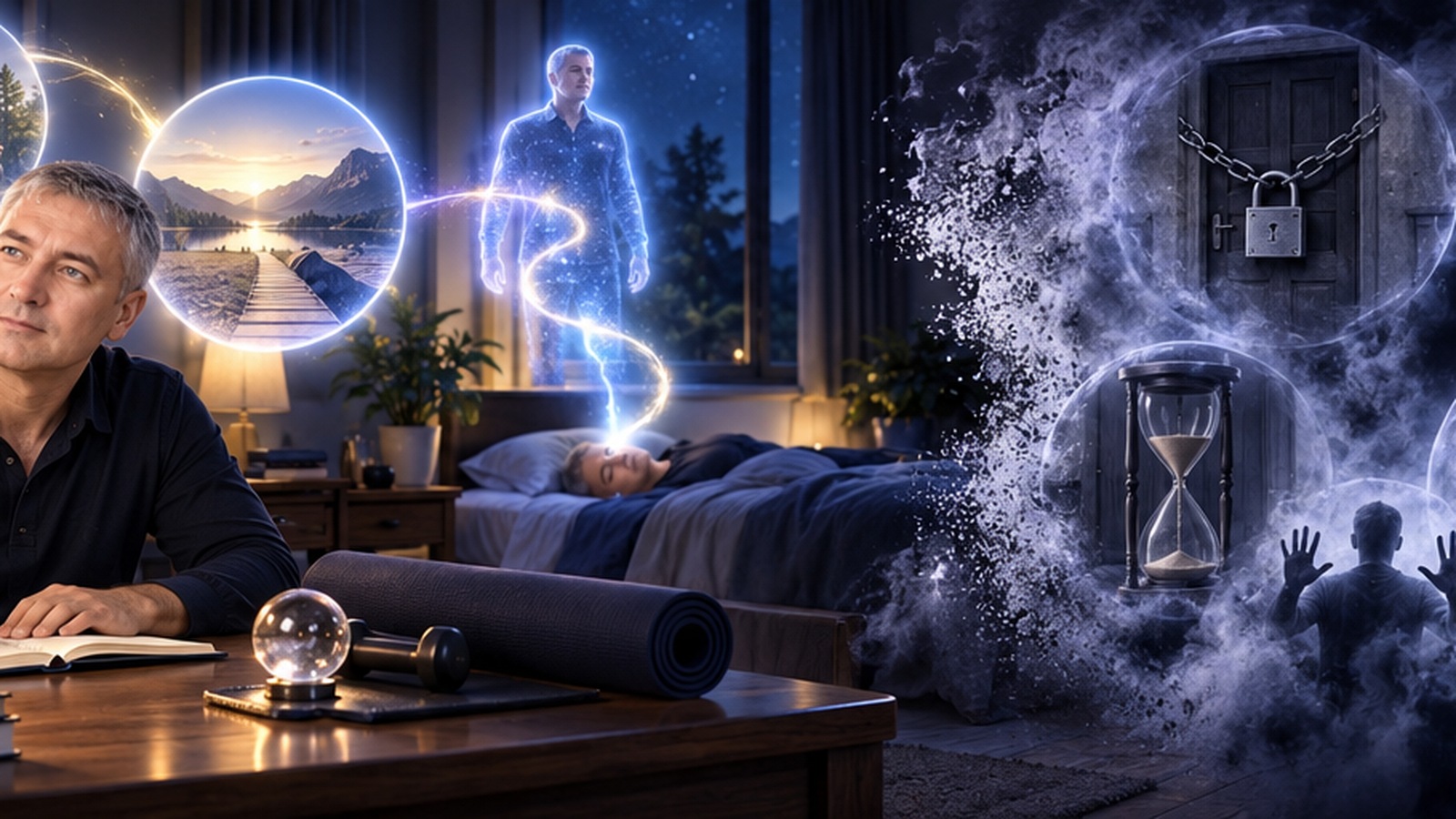
Out-of-body experience is surrounded by fear. People worry that they may not return, lose their connection with the body, allow another entity to enter it, or accidentally find themselves in a dangerous world.
In twenty years of practice, I have found no reason to consider conscious separation deadly. Consciousness naturally separates partially from the body during sleep. Its connection with the organism remains intact, and a strong emotion, an external sound, or the body’s need to awaken usually brings an immediate return.
That does not mean the practice should be treated carelessly. Real risks exist. They are simply different from the popular horror stories.
Myth: you may be unable to return
Returning to the body does not require finding a route back. Consciousness retains its natural connection with the organism. In my experience, the intention to return is enough—and sometimes the body ends the practice sooner than I would like.
The fear of being “trapped forever” usually comes from religious stories, movies, and a lack of personal experience. It can create a frightening mental scene, but it does not sever the connection with a living body.
Myth: someone else can take your body
The physical body is not an empty house with an unlocked door. Its biology, memory, and energy structure are connected to a particular consciousness.
I have encountered different forms of consciousness and observed attempts at contact, pressure, or the reading of information. That does not mean an outside being can simply replace a person in his body during ordinary practice.
Myth: every separation attracts dangerous entities
The second energy level contains different beings, just as the physical world does. Most encounters are neutral or benevolent. Many frightening forms are also created by the practitioner’s own fear.
This is not a reason to label every threat imaginary. Independent beings exist, and not every interaction is useful. But the expectation of attack reduces perceptual accuracy and strengthens mental constructions.
The best foundation for safety is clarity, calm, and the ability to end contact.
A real risk: physical health
Some preparatory methods affect breathing, sleep, the nervous system, and arousal. A person with health concerns should discuss a particular strain or technique with a physician.
Do not use extreme sleep deprivation, dangerous breathing exercises, psychoactive substances, or physical exhaustion to force an unusual state. Such methods may produce an experience while reducing clarity and increasing risk to the body.
Out-of-body experience is valuable because of awareness. A method that damages health and control defeats the purpose of the practice.
A real risk: fear and loss of balance
A first separation can feel so realistic that it causes shock. Vibrations, noise, temporary inability to move the physical body, and unfamiliar perception can be frightening when a practitioner does not understand what is happening.
Preparation reduces this risk. A person should know what sensations may occur and remember that the experience can be ended.
If practice produces persistent anxiety, disrupts sleep, or creates fear of ordinary life, take a break. Investigating consciousness should not become a struggle against oneself.
A real risk: escape from physical life
Unusual worlds can be vivid and compelling. A person may begin living for the next separation and lose interest in work, relationships, and the body.
That is not development; it is dependence on an experience. Out-of-body practice reveals its value when it makes physical life more meaningful and the practitioner more responsible. When it becomes a way to avoid real problems, it leads away from its purpose.
A real risk: gullibility after a powerful experience
A dramatic encounter may convince someone that he has received absolute knowledge. He begins following instructions from an unknown being, making important decisions from symbols, or seeing himself as chosen.
No experience cancels critical thinking. Information must be tested, and decisions about health, money, and relationships should be made in a clear physical state.
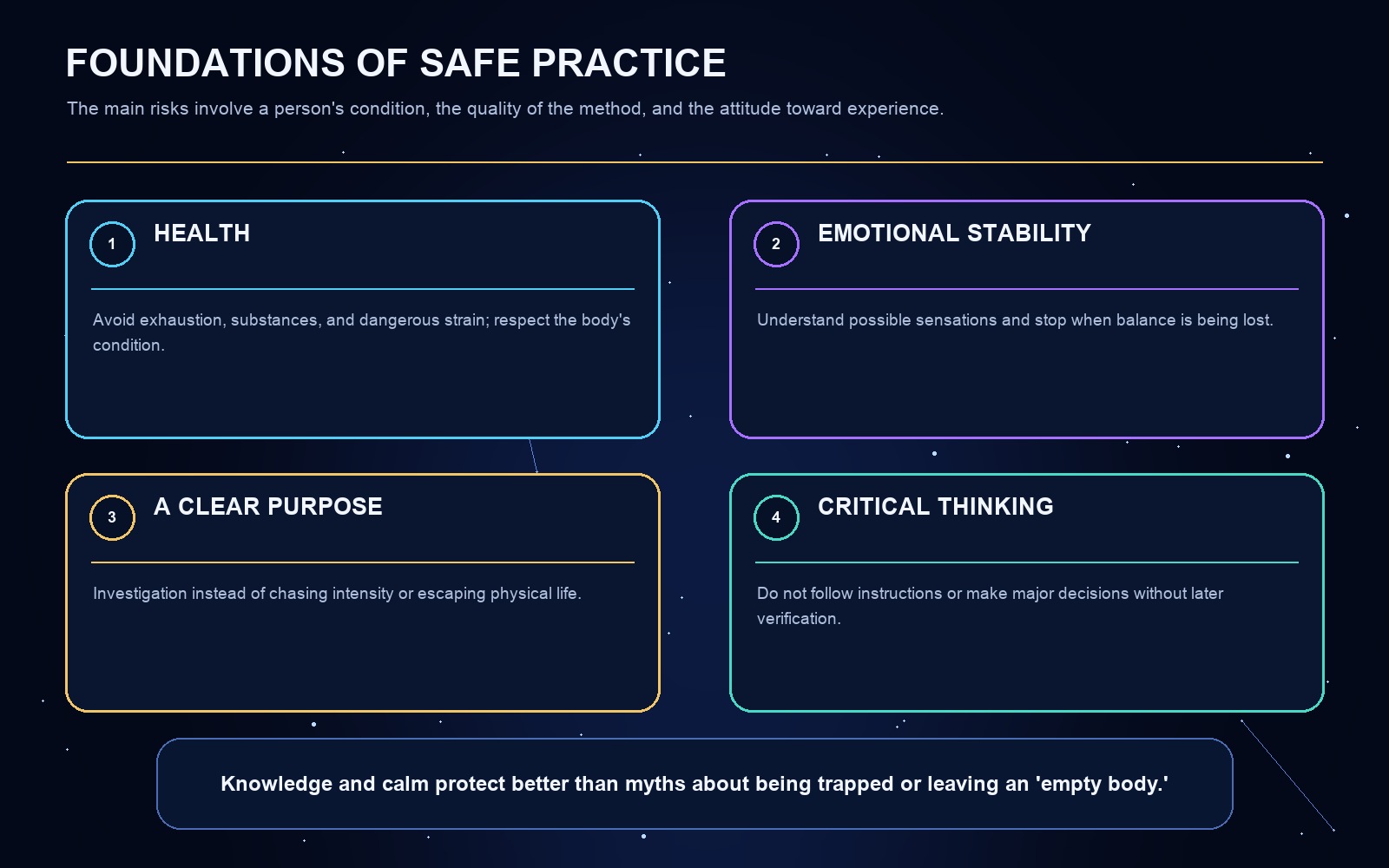
Foundations of a safe approach
Safety begins before separation.
- Practice from a stable physical and emotional condition.
- Do not use substances or dangerous methods of altering consciousness.
- Understand the possible stages and sensations.
- Choose a clear purpose instead of chasing intensity at any cost.
- Do not enter contact from fear or the desire to prove courage.
- End the experience if control is slipping.
- After returning, restore attention to the body and ordinary reality.
- Record the experience and analyze it later, without emotional haste.
Safety does not require constant fear
I consider the nearest nonphysical level generally safer than the physical world. Thought and intention have greater power there, while return to the body remains a natural way to end the experience.
Safety, however, does not come from denying every risk. It comes from knowledge, preparation, and inner stability.
There is no need to build a cult of danger around the practice. There is also no reason to turn it into irresponsible entertainment. We are investigating a reality we do not yet fully understand. Respect for it is a sign of maturity, not fear.
You can read more about preparation, possible encounters, and the principles of safe practice in my book The Phenomenon of Consciousness Beyond the Body.
Continue with the book on Amazon: Kindle Edition or Paperback.
Leave a Reply