Two people can follow the same preparation and receive completely different results. Even one practitioner’s experiences never repeat in exactly the same way. In this article, I answer four questions that help explain this variability while also pointing toward the patterns behind the changing forms.
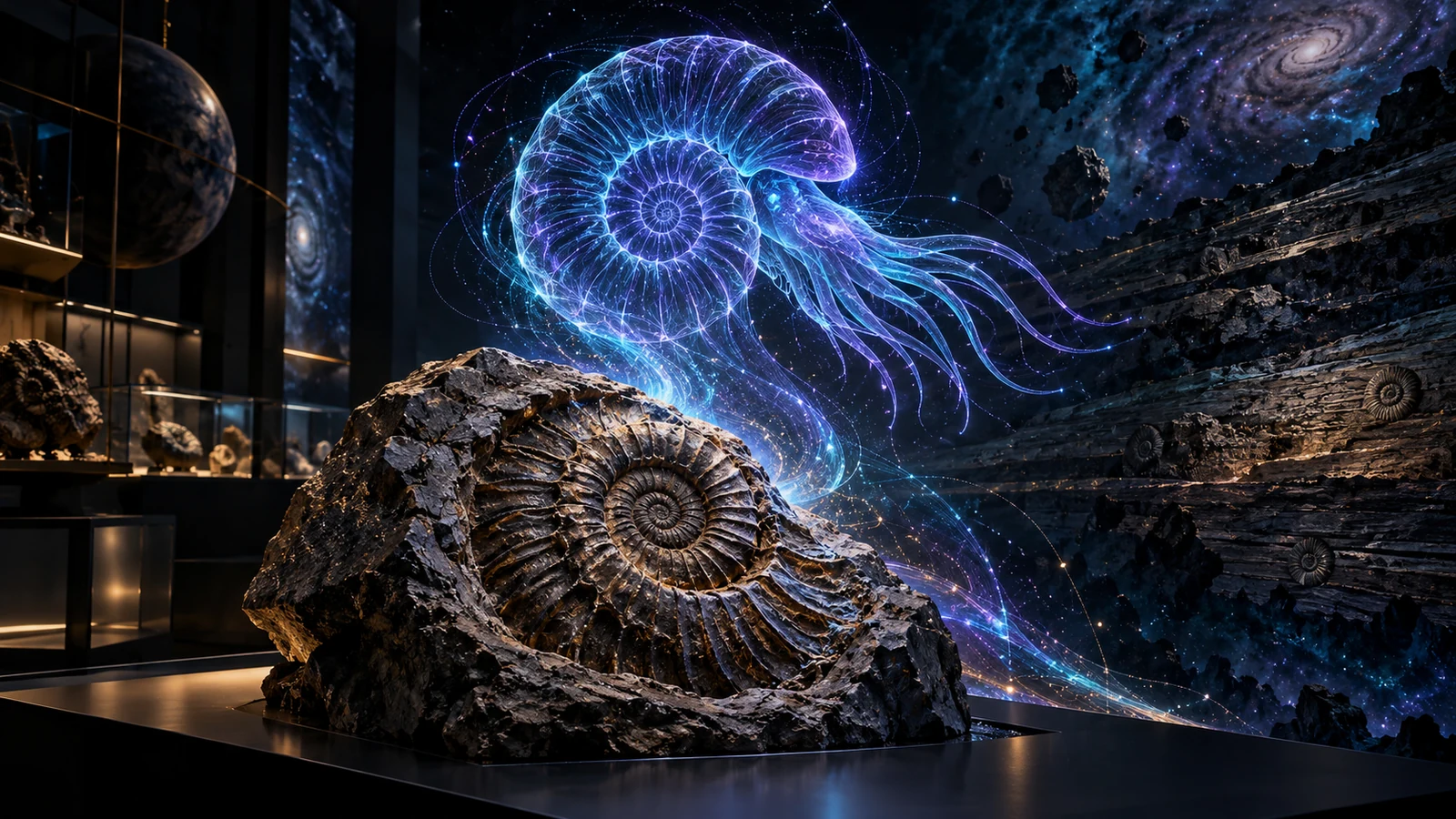
What is the energetic trace of a fossil?
*Short answer: I use the term energetic trace for a preserved reflection of a material object’s form and history on a subtler level of reality. It is not the ancient creature itself, and it does not prove that the creature continues to live.*
My observations have led me to conclude that matter in the physical world produces an energetic reflection on the nonphysical level closest to us. This reflection repeats the source object’s form, but it is not a fixed and perfect copy. It may preserve an earlier state, gradually weaken, or change under the influence of consciousness.
A fossil is especially interesting because it carries the form of a being that lived millions of years ago. In the physical world, we see mineralized remains or an impression. On the energetic level, not only the present stone but also a deeper trace of the form connected with its origin may remain.
It is easy to mistake such a trace for a living being or a scene from the past. A vivid image alone is therefore not enough. We need to observe whether it reacts to the researcher, displays independent behavior, changes as we approach it, and corresponds with information that can later be checked.
I classify an energetic trace as a form of matter’s memory, rather than the consciousness of a dead organism. It resembles an event imprinted in the structure of space. How long such traces remain and how much information they can preserve are still open questions for research.
How does age affect the vividness of conscious experiences?

*Short answer: age affects the condition of the body, sleep patterns, and stability of attention, but it does not by itself determine a person’s capacity for a vivid out-of-body experience. Awareness and skill are often more important than the number of years lived.*
Children have more flexible perception. They have not yet fully accepted society’s belief that only the physical world is real. Unusual states can therefore arise naturally. Yet children often lack the experience, language, and control needed to understand and preserve what happened.
An adult has a different advantage. The mind is more stable, and the person can define a task, compare observations, and keep systematic records. At the same time, habits, fears, and a constant stream of thought can make transition more difficult.
Later in life, the body may tire more quickly, sleep patterns can change, and medication or health conditions may affect perception. This does not mean the path is closed. Reduced external pressure, accumulated life experience, and a calmer relationship with death may help a person perceive the experience more deeply.
I do not consider age the main limitation. Practice needs to match the condition of the body, and results should never be forced through exhaustion. Consistency, calmness, clear intention, and the ability to sustain attention provide a more reliable foundation than searching for the “ideal age.”
Can we change the familiar laws of perception in an out-of-body state?

*Short answer: yes. In an out-of-body state, intention can change the way we move, the form of the perceived body, the intensity of the senses, and the way we interact with space. It is more accurate, however, to speak of entering a different set of rules than of abolishing the laws of the universe.*
In the physical world, movement is constrained by mass, distance, and the resistance of matter. On the second energy level, thought influences form and direction much more quickly. A person can rise, pass through a familiar barrier, change the point of view, or move toward an object by focusing on it.
Sight, touch, and other senses can be intensified, and we can temporarily stop using the familiar human form. Most practitioners continue to perceive themselves as human because this form is deeply embedded in their sense of identity.
Not everything obeys a passing wish. Space has its own structure, other consciousnesses possess their own will, and the practitioner’s awareness is limited. If someone expects complete omnipotence, that expectation itself begins to distort perception.
I therefore test changes gradually: I form one intention, observe the result, and distinguish actual interaction from an image created by my own mind. The ability to influence perception makes exploration richer, but it also demands stricter discipline over thought.
Why does the same preparation sometimes lead to different regions of experience?

*Short answer: a technique creates the conditions for transition, but it does not determine the exact destination. Direction is shaped by intention, emotional state, expectations, degree of awareness, and whatever holds our attention at the moment of separation.*
Two experiences may begin in the same way: relaxation, a change in the perception of the body, sound, vibrations, and separation. One person then enters a reflection of the bedroom, another moves instantly into an unfamiliar space, and a third loses awareness and slips into an ordinary dream.
The reason is that our inner setting never repeats perfectly. Even a carefully chosen goal competes with background thoughts. Fear pulls us back to the body. Strong expectation creates a thought-form. Remembering someone may direct us toward that person—or toward an image the mind has constructed from memory.
The quality of the transition also matters. When awareness is weak, a person follows familiar scripts. With clear attention, there is a greater ability to maintain direction and examine the environment. Sometimes an experience leads somewhere other than the intended destination, yet that very surprise produces the most valuable information.
A technique should not be treated like a ticket with the destination already printed on it. It is a way to open a door. The route beyond that point depends on the researcher’s condition and the structure of the space being entered.
To recognize patterns, record not only the result but also the conditions: the time, degree of fatigue, mood, goal, features of the transition, and first thoughts after separation. A series of such records reveals more than a single spectacular experience.
Differences between experiences do not mean that no order exists. They reveal how many factors take part in the interaction between consciousness and nonphysical reality. The researcher’s task is not to force every experience to repeat the last one, but to learn to recognize stable patterns beneath changing forms.
For a deeper discussion of the energy levels, the properties of perception, and my research method, see The Phenomenon of Consciousness Beyond the Body: Kindle Edition or Paperback.
Leave a Reply