
Regression requires trust. A person closes their eyes, relaxes ordinary control, and allows another professional into a deeply private area of experience. That is why a practitioner should never be chosen solely because of an attractive website, a promise to “show you a past life,” or one enthusiastic testimonial.
A good practitioner does not sell a miracle. The practitioner creates conditions in which the client retains freedom, clarity, and the right to disagree with any interpretation.
Experience Matters More Than an Impressive Title
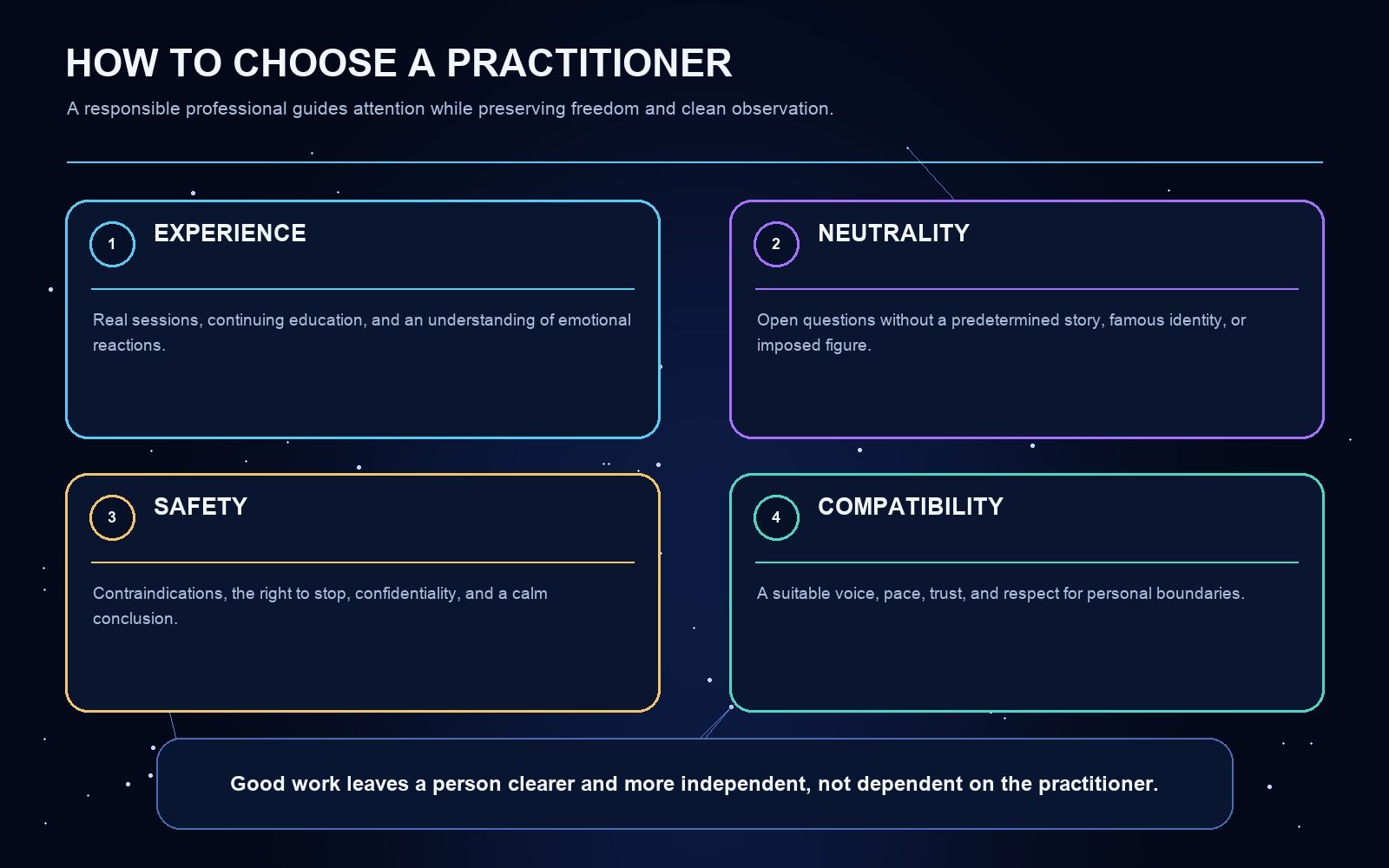
A regression practitioner should have real experience conducting sessions. Ask how many years the person has worked, approximately how many sessions they have conducted, what kinds of concerns they address, and how they continue their education.
A background in psychology, medicine, or another helping profession can be valuable. It does not guarantee quality, but it helps a practitioner understand emotional reactions, trauma, professional boundaries, and responsibility for a client’s condition.
A certificate alone is not proof. What matters is how the practitioner thinks, communicates, and guides the session.

Neutral Questions Instead of a Predetermined Script
The quality of a regression practitioner is often most visible in the questions they ask.
“Look at who killed you” has already introduced a murder. “What is happening?” leaves room for an actual answer. “Your spiritual guide is coming to you now” imposes a guide. “Do you independently perceive anyone or anything nearby?” is much cleaner.
A practitioner should not use the client to prove a personal theory. The task is to support attention, not write the story.
Be Wary of Promises of Exceptional Results
Warning signs appear when a practitioner promises in advance to:
- reveal a past life with absolute certainty;
- identify the exact cause of any illness;
- discover a famous incarnation;
- eliminate every problem in one session;
- obtain an infallible answer from higher powers;
- prove that people around you are enemies, karmic debtors, or energetic aggressors.
Such promises intensify expectation and dependency. If nearly every client turns out to have been a pharaoh, priest, or major historical figure, that says more about the method than the scale of the discovery.
Questions to Ask Before a Session
Before paying, arrange a short conversation and ask direct questions:
- How should I prepare?
- What conditions would make a session inappropriate?
- How do you respond to a strong emotional reaction?
- Will the session be recorded, and who owns the recording?
- What happens if I see nothing?
- How do you distinguish observation from fantasy and suggestion?
- Can I stop the process at any time?
- Is there time for a calm return and discussion afterward?
- How is confidentiality protected?
A professional answer will be clear and specific. Irritation, pressure, and vague language are poor signs.
Personal Compatibility Matters
Even a good practitioner will not suit everyone. One person responds best to a calm, low voice. Another feels more comfortable with a woman, and someone else with a man. Some people need a gentle pace; others need more structured guidance.
Notice whether you feel calmer in the practitioner’s presence. Does the person hear your actual concern? Respect your boundaries? Or try to impress you with stories about personal abilities?
A friend’s recommendation is useful, but it does not replace your own judgment. A method that helped someone else may not be right for you.
What a High-Quality Session Looks Like
Good work is not measured by the number of vivid images. Sometimes the most valuable result is one clear image or insight that connects events that had long seemed unrelated.
During a session, a responsible practitioner:
- does not rush or judge the answers;
- asks open-ended questions;
- does not replace the client’s words with their own;
- helps distinguish sensation, image, and interpretation;
- monitors the person’s condition;
- does not use fear;
- calmly accepts the absence of a result;
- returns responsibility for conclusions to the client.
After the session, the practitioner should not declare one mandatory explanation. It is more useful to discuss what was directly experienced and what remains a hypothesis.
Verification Continues After the Eyes Open
A powerful regression can feel completely real. The intensity of the experience does not verify every detail.
When verifiable information appears, write it down before searching online or discussing it with other people. If the information may influence an important decision, return to it later, compare it with other sources, and examine its consequences in ordinary life.
Never accuse a relative, end a relationship, refuse treatment, or make a major financial decision solely because of a regression scene.
A Practitioner Should Never Become the Owner of Your Reality
The central measure of quality is not the practitioner’s power but the growth of your awareness. Work with a good practitioner should help you understand yourself more clearly and become more independent.
If someone insists that only this particular master can protect you, cleanse you, interpret your experience, or connect you with the Higher Self, dependency is being created. That is the opposite of development.
A regression practitioner can guide you through part of the path. You must still walk it, verify what you received, and make your own decisions.
Choose someone who can accompany you carefully into the unknown without claiming the right to decide what you must see.
For more on consciousness, the soul’s memory, and the verification of extraordinary experience, see my book *The Phenomenon of Consciousness Beyond the Body*.
Leave a Reply