
Vibrations are among the most distinctive sensations reported by people who have out-of-body experiences. They are discussed often, yet the descriptions are frequently so vague that almost any bodily sensation gets labeled a vibration: goosebumps, trembling, a pulse, muscle tension, or an ordinary noise inside the head.
In my experience, true vibrations are difficult to confuse with anything else. Once you have experienced them, you know what people are referring to. This is not a metaphor or a dramatic name for an unusual mood. The vibrations are felt physically, deep inside the body, as though the entire nervous system has temporarily shifted into a completely different mode.
I have observed this state many times during twenty years of practice. In this essay, I want to explain what I mean by vibrations, what they feel like, why they arise, whether they are always necessary, and what to do when they appear.
What Happens to Consciousness
This is how I understand the process.
By its nature, the soul belongs to a higher energetic level than the physical body. When it incarnates, it connects with the material organism and uses the brain and nervous system as its means of communication. This connection allows consciousness to perceive the physical world, direct the body, and receive information through it.
In an ordinary state, consciousness is tuned to the level of reality occupied by the body. We do not notice this tuning because it remains constant. Just as a person eventually stops hearing a steady background sound, consciousness does not perceive its own frequency while it remains in its familiar condition.
During an out-of-body experience, that tuning changes. Consciousness is no longer fully bound to the physical level and shifts into another range of perception. The nervous system responds to that transition, and we experience its response as vibrations.
For me, then, vibrations are not a mysterious force that somehow pushes a person out of the body. They are the reflection of a deeper process. Consciousness changes levels, and the body registers that change in the only way available to it.
The process can be compared to tuning a radio from one frequency to another. While the receiver is aligned with a station, the sound is stable. As it moves between frequencies, noise appears. Something similar happens here: the vibrations arise during the transition itself.
Once the transition is complete, they may stop. Consciousness has already entered another state and is no longer moving through the threshold between levels.
What True Vibrations Feel Like
The essential distinction is that these vibrations are felt inside the body, not on the surface of the skin.
They are not goosebumps running down your arms or back. They are not chills or trembling from cold. They are not a pulse in the blood vessels or a small involuntary muscle twitch. The sensation is much deeper and may involve the entire body.
The closest comparison I can offer is electrical muscle stimulation, when electrodes are placed on the body and deliver rapid impulses. During an out-of-body transition, however, the source does not feel external. The fast, rhythmic impulses seem to arise from within and move through the nervous system.
The vibrations may begin in different places for different people. In my case, they often start around the solar plexus or chest. Sometimes they begin in the head. When that happens, the sensation can interfere with my concentration, so I move my attention lower, toward the chest, and the vibration follows my attention.
With practice, a person begins to understand that the vibration can be directed. It can be moved through the body, expanded, intensified, and brought to a level at which separation becomes much easier.
The first weak signs may feel like a distant tingling or a barely perceptible inner tremor. At that point, the state has not yet reached its full strength. Attention, visualization of moving energy, or breathing can intensify it. The faint impulse gradually spreads through the body and becomes clear, powerful, and unmistakable.
Words cannot reproduce the sensation completely. But after experiencing it once, a person will recognize it again without needing further explanation.
What Is Often Mistaken for Vibrations
One common misunderstanding involves the muscles around the ears and jaw. When people yawn or intentionally contract these muscles, they may hear a rumbling sound inside the head. Some believe they have learned to produce the vibrations this way.
That is a different phenomenon.
Muscle tension does create an internal sound, and it can faintly resemble one of the effects that accompanies the transition. But the sound itself is not the deep vibration that occurs as consciousness changes state.
True vibrations are not created simply by tensing muscles. They are not confined to the area around the ears, and they do not disappear like an ordinary muscular sound. They move through the body from within and are experienced as part of the larger transition.
The following should not be confused with them either:
- the pulse of blood;
- goosebumps;
- chills;
- trembling from fatigue or cold;
- involuntary muscle twitching;
- ringing or familiar background noise in the ears.
The confusion occurs because the mind tries to explain an unfamiliar state by comparing it with something familiar. What makes a true vibration distinctive is precisely its unfamiliarity. Under ordinary conditions, most of us do not experience anything like it.
A Noise Like a Passing Train or Jet Engine
Vibrations are often accompanied by a powerful internal sound. It may seem as though a train is passing nearby or a jet engine is running beside you. The sound can be so strong that the first experience may be startling or frightening.
I understand this noise as another expression of the same transition. The nervous system and the organs of perception continue to transmit information, but consciousness is already leaving its ordinary mode. As a result, the transition is perceived not only as vibration but also as an intense internal sound.
The vibration and the noise often appear together, although this is not an absolute rule. Sometimes only the noise is present. This happens especially often when a person enters the state between waking and sleep very quickly.
After extreme fatigue, for example, a person may begin falling asleep almost immediately. If awareness can be preserved during that descent, a growing noise may appear before any noticeable vibration. This is also a signal: the transition has begun and can be used for separation.
Are Vibrations Required?
No. An out-of-body experience is possible without them.
In my practice, vibrations and internal noise accompany approximately eight out of every ten separations. The remaining experiences unfold differently. Sometimes consciousness separates so smoothly that the body does not register the transition as a strong vibration. Sometimes the person becomes aware only after separation has already occurred.
Vibrations are therefore not a required mechanism. They are a consequence of the process and, at the same time, a useful point of reference.
Their value lies in their clarity. When they appear, I understand that the state has been reached, the transition is underway, and it is time to act. This is not the moment to continue waiting, analyze every sensation, or wonder whether the vibrations are strong enough. It is the moment to use a separation technique.
If the vibrations stop, there are two possibilities. Consciousness may have returned to its ordinary state and the opportunity may have passed. Or the separation may already be complete, while the person still assumes that he or she is lying in the physical body.
When the vibrations end, it is therefore useful to test the state. Try to rise without using the physical muscles, turn, roll out, float upward, or move attention to another location. A person may discover that consciousness is already outside the body and simply has not moved away from it.
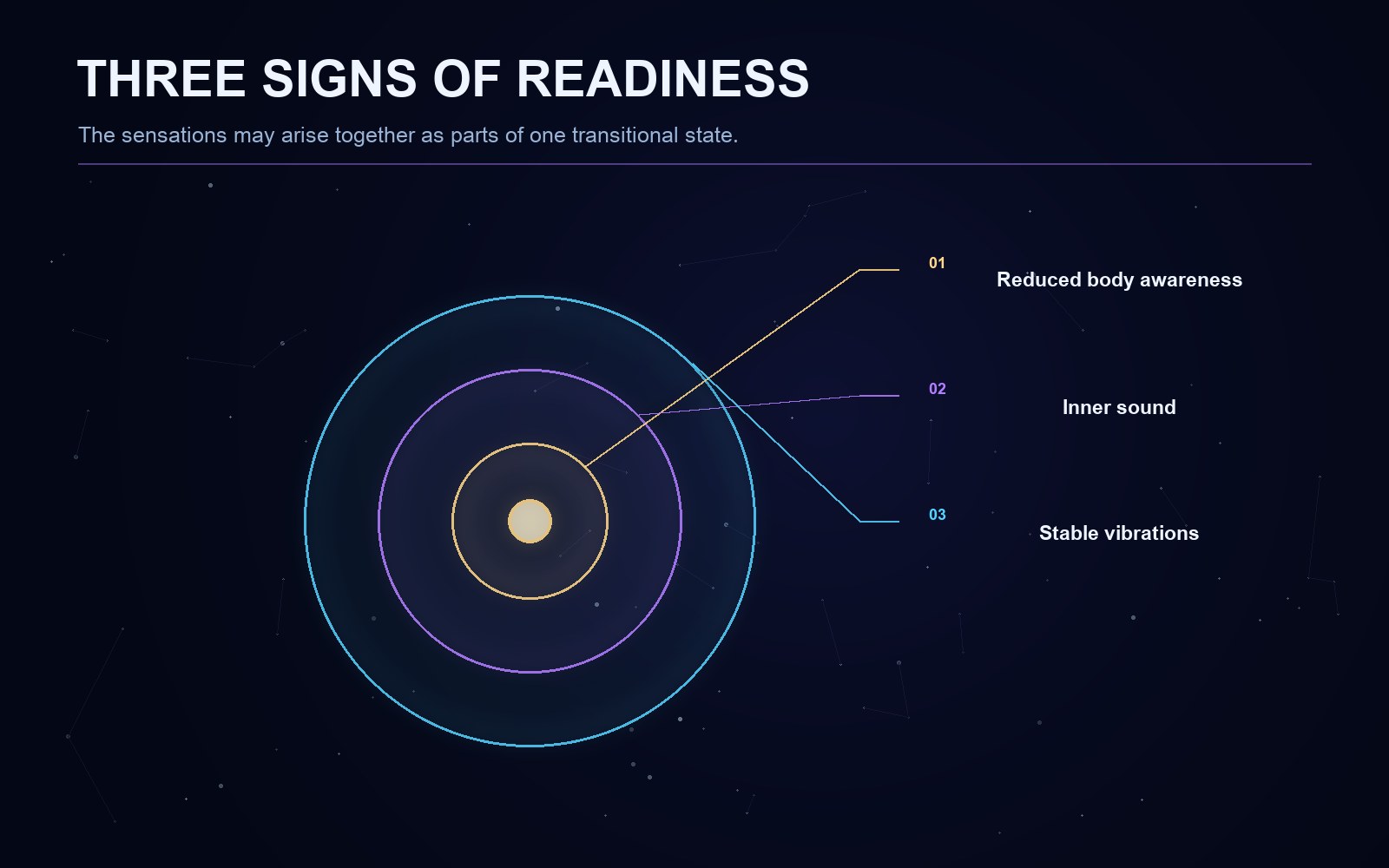
Three Signs That Separation Is Possible
Over the years, I have identified three especially clear signs of transition.
1. A Deep Internal Vibration
This is the most obvious signal. It may begin in one part of the body, spread, and become stronger. When it is clearly present, the moment for separation is either close or has already arrived.
2. A Powerful Internal Sound
The noise may accompany the vibration or appear on its own. Its growing intensity indicates that consciousness is in a transitional state. Sometimes this signal alone is enough to begin a separation technique.
3. Seeing With Closed Eyes
For a long time, this third sign seemed especially strange to me. I would be lying down with my eyes closed, yet I could see the room around me. At first, I assumed I had already fallen asleep or entered a dream. Later, when I learned to leave the body directly from this condition, I understood that separation had already occurred.
Consciousness is no longer perceiving in the ordinary physical way, but it still occupies the same position as the body. The person therefore assumes that he or she is still lying there. The vibrations may already be gone because the transition is complete.
If you can see the surroundings while your eyes remain closed, there is no reason to wait for another sign. Move away from the body: rise, roll out, float upward, or direct your attention toward a chosen location.
This third sign explains many experiences that occur without vibrations. The person does not feel the transition because awareness returns only after it has taken place.
How Vibrations Arise
Sometimes the vibrations appear spontaneously. In my own practice, this has happened after a demanding day, a long drive, or intense fatigue. I would lie down and relax deeply, and the transition would begin without any special preparation.
There is no reason, however, to deliberately exhaust yourself for the sake of practice. Fatigue may help the body relax quickly, but it also makes it more likely that awareness will simply fade and the person will fall asleep.
A more deliberate approach begins with relaxation. The body must gradually stop demanding attention. Meditation, quiet observation of the inner state, or any familiar relaxation method can help.
The next step is working with attention and visualized energy. I describe these exercises in detail in my book. The purpose is not merely to lie still and wait for something unusual to happen. It is to direct consciousness inward, sense the movement of energy, and prepare for the transition.
Breathing can strengthen the process. It is not required; vibrations can arise without it. But when the sensation begins faintly and remains weak, breathing may help intensify it and spread it through the body.
At first there may be only a subtle impulse. It then grows denser and involves a larger area. At a certain point, the person clearly understands that the body has entered the appropriate state. That is the moment to move toward separation.
Waiting for vibrations should not become a tense pursuit of results. Intention helps establish a direction, but constantly asking, “Has it started yet?” holds consciousness in its ordinary mode. The process requires physical relaxation combined with clear awareness.
Why Morning Is Easier Than Evening
In the evening, the transitional state often comes quickly. After a demanding day, the body wants to sleep, so relaxation, noise, and even vibrations may appear almost immediately. The difficulty is that the window between wakefulness and sleep can be extremely brief.
A person notices the first signs but loses awareness and falls asleep seconds later. Using the evening transition successfully requires experience.
Early morning offers different conditions. The body has rested, yet consciousness remains close to sleep. I do not mean nine or ten in the morning, but the time of a natural early awakening—perhaps four, five, or six o’clock. The exact time differs from one person to another.
The morning transition window is usually wider. A person can awaken, remain still, relax again, and enter the border state without losing awareness too quickly. Even if the first attempt ends in sleep, another awakening may provide a new opportunity.
Several such opportunities can arise in a single morning. For that reason, a beginning practitioner will often find it easier to notice the vibrations, recognize the transition, and use a separation technique in the morning.
With experience, the dependence on timing decreases. A person learns to relax, direct attention, and enter the necessary state during the day or evening. At the beginning, however, morning usually provides the most natural conditions.
What to Do When the Vibrations Appear
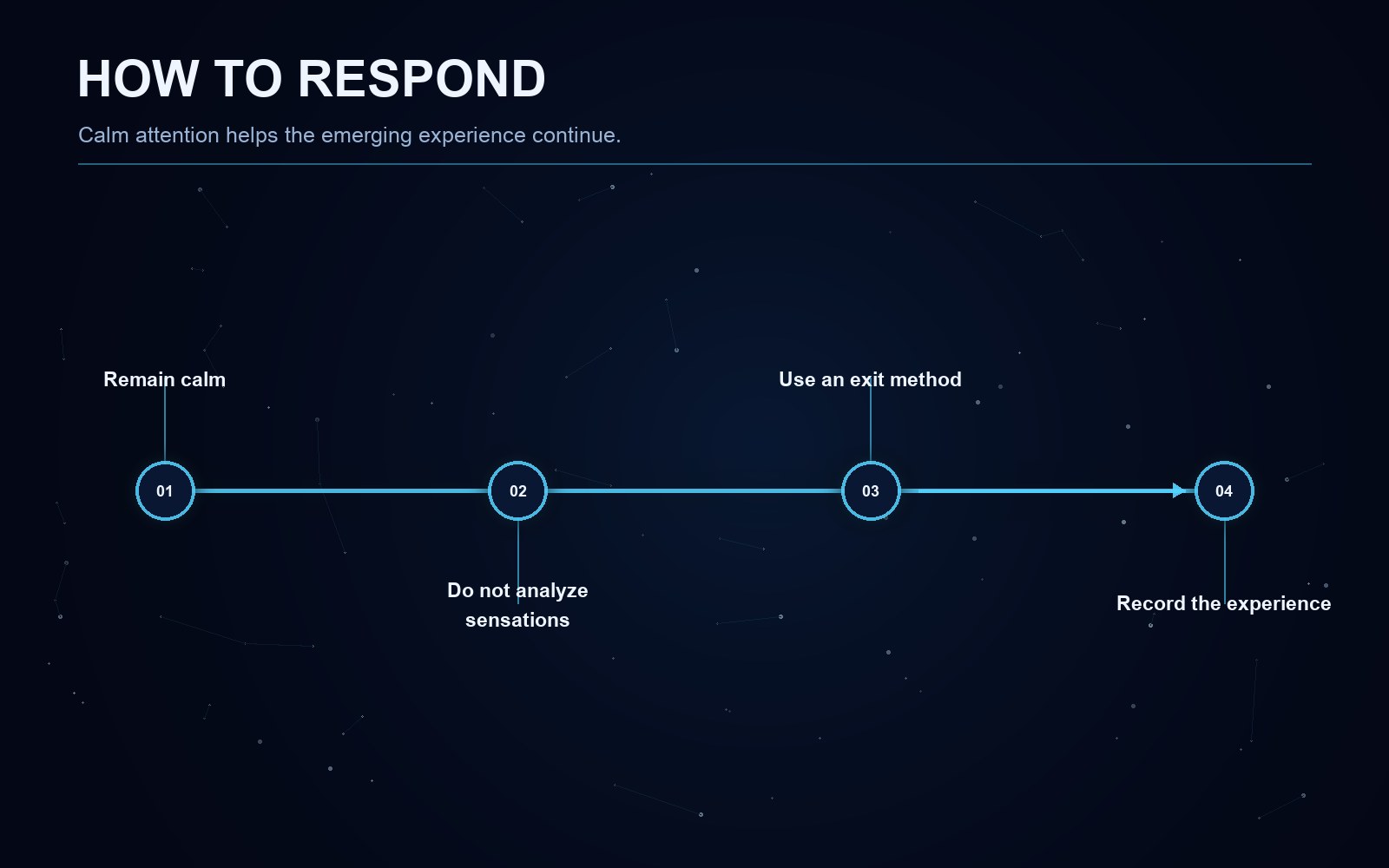
The most common mistake is to continue waiting.
A person prepares for a long time and finally feels the vibrations, but instead of acting, begins observing them, measuring their strength, comparing them with other people’s descriptions, and wondering whether they are real. The state may disappear while all this analysis is taking place.
Vibrations are a signal to act.
If they are still weak, attention can be directed toward their center. You can imagine them spreading through the entire body or strengthen them with breathing. Once the sensation becomes clear and stable, use a separation technique.
There are several possible approaches:
- rise without engaging the physical muscles;
- roll to one side;
- imagine floating upward;
- feel yourself climbing an imaginary rope;
- move your attention to a location chosen in advance.
No single technique is equally natural for everyone. One person may find it easy to rise, while another will find it easier to roll out or float upward. It helps to know several methods in advance and use whichever comes to mind first during the transition.
Once separation has occurred, move away from the physical body. Remaining close to it can quickly return consciousness to its ordinary state.
From a Mysterious Sensation to a Practical Sign
The first vibrations may feel inexplicable. A person does not know what is happening, searches for a familiar comparison, and may be frightened by the intensity. With practice, the uncertainty disappears.
Gradually, the vibrations become a familiar signal. A person learns where they begin, how they spread, what strengthens them, and when to act. Later, it becomes possible to guide them with attention while maintaining awareness through the transition.
For me, vibrations stopped being a goal long ago. I do not consider an experience unsuccessful when they fail to appear, and I do not try to produce them at any cost. They remain one of several signs that help me recognize the state of consciousness.
The out-of-body experience itself matters far more than the sensations surrounding it. Vibrations may open the door, but the investigation begins beyond that door.
What These Observations Reveal
Vibrations reveal how closely consciousness, the body, and the nervous system are connected. They arise at the boundary between two states, where the familiar mode of perception loosens and another becomes possible.
My explanation is not based on one accidental experience. It developed through repeated observation over twenty years of practice. I have seen which signs arise together, which can appear independently, when vibrations lead to a successful separation, and when they disappear without one.
These observations led me to several conclusions:
- vibrations reflect the transition of consciousness but do not create it;
- they are not required for an out-of-body experience;
- internal noise and seeing with closed eyes can indicate the same process;
- the appearance of vibrations means that the time for waiting is over and the time for action has arrived;
- the ability to recognize the transition develops through practice.
The essential point is to rely on direct observation. Other people’s descriptions can provide direction, but they cannot replace personal experience. When a person encounters true vibrations for the first time, an inner point of reference appears—something that cannot be acquired from books or videos alone.
Vibrations are not the destination. They are one of the languages through which the body tells us that the familiar boundary of perception is changing and consciousness is ready to move beyond it.
This essay explores only one aspect of out-of-body practice. In Phenomenon of Consciousness Outside the Body, I discuss my model of consciousness, energetic levels of reality, meditation, visualization, breathing, and separation techniques in greater depth. The book places individual experiences within a larger system and explains the path that led me to these conclusions.
Leave a Reply