
The next part of my personal story: my first attempts to repeat the experience, the unexpected discoveries, the mistakes, and the patterns that became the beginning of my twenty-year investigation of consciousness beyond the body.
The first thing I noticed was that the wallpaper looked lighter.
It was late at night. I was lying on the couch after a long drive, trying to repeat my first conscious out-of-body experience. I waited for the familiar vibrations and the roar inside my head, but nothing like that happened. The room remained quiet. Only the wall looked different, as though moonlight were falling across the wallpaper.
I decided to get up and take a closer look. I walked over to the wall, ran my hand across it, and felt a faint vibration in my fingers. I pressed a little harder. The surface yielded. My hand slowly began to sink into the wall, then passed through it.
Only then did I understand: I was already outside my body.
I turned toward the couch and saw myself lying there. In the same instant, I was back.
The entire experience lasted no more than two minutes. Yet those two minutes taught me one of my first important lessons: leaving the body is not always accompanied by dramatic effects. Sometimes the transition feels so natural, and the surrounding space looks so convincing, that a person may not realize it has happened.
The most astonishing part was not that my hand had passed through the wall. What struck me more deeply was that until that moment, I had been certain I had simply gotten up from the couch physically.
That was when an isolated extraordinary event began to become an investigation.
After the First Experience
After my first fully conscious out-of-body experience, I tried to understand what circumstances had made it possible.
That day, I had spent many hours behind the wheel and driven roughly five hundred miles. During the trip, my attention had shifted several times into an unusual state of deep concentration. Later, when I lay down to rest, a powerful inner roar filled my head and vibrations moved through my body. Then I found myself outside the physical body.
I remembered the sequence and concluded that the vibrations and inner sound might signal an approaching separation.
For several evenings, I lay down, relaxed, and waited for them. I listened to every sensation, remained as still as I could, and directed my attention inward. Nothing happened. I simply fell asleep.
I tried practicing during the day, when I was not tired. The result was the same.
Looking back, I see how naive those first attempts were. I expected that reproducing a few external conditions—lying down, closing my eyes, relaxing, waiting for vibrations—would cause the experience to repeat. But consciousness does not work like a mechanical switch. The depth of relaxation matters. The quality of attention matters. So do one’s inner state, the moment of transition, and many other factors I had not yet learned to recognize.
The failures did not discourage me. They helped me separate the event itself from my first assumptions about it. I began to understand that if I wanted real answers, I could not rely on a formula discovered by chance. I would have to observe, compare, and test.
The Experience I Mistook for Ordinary Waking Life
A few days later, I made another long drive. On the way back, my attention once again entered that familiar altered state. I did not regard this as an established method, and I would never advise anyone to experiment with consciousness while driving. It was part of my history, a circumstance whose importance I understood only later. Every deliberate attempt took place at home, in a safe environment.
I returned late at night, completely exhausted. I did not want to miss an evening of practice, so I lay down on the couch and directed my attention inward.
I waited for the vibrations. I waited for the inner sound. Nothing happened.
But the room began to look slightly different. The wallpaper seemed much lighter than usual. I thought moonlight might be coming through the window, so I got up and walked over to the wall.
What followed was the moment that opens this essay: the faint vibration in my fingers, the surface that was no longer solid, my hand moving into the wall, and the sudden realization.
I had already left my body without noticing it.
The experience changed my understanding of the transition itself. I had assumed that leaving the body would always be unmistakable: powerful vibrations, an inner roar, a clear sensation of separation, a sudden change in perception. Now I saw that consciousness could move beyond the body quietly, without a dramatic threshold. I still perceived the familiar room and retained my ordinary clarity of thought. My position in space also felt natural: I had been lying on the couch, then I stood up and walked to the wall. My mind automatically offered the most familiar explanation—I had simply awakened and gotten up.
The only clue was the slightly altered color of the wallpaper.
That became an important observation. A familiar-looking environment does not necessarily mean the state of consciousness has remained the same. Sometimes the difference is hidden in a small detail that is easy to overlook.
The First Patterns
Within ten days, I had two successful out-of-body experiences despite having almost no deliberate practice. That gave me confidence, but it also raised new questions.
I compared the two events and identified my first working patterns.
The altered state of attention that followed sustained concentration clearly played an important role. Physical exhaustion helped the body relax quickly, but it guaranteed nothing. Vibrations and inner sound could accompany a separation, but the second experience showed me that they were not required. The room could look almost identical to physical reality. And seeing my own body ended the experience immediately.
These were not final laws. They were working observations—the first points on a map that had not existed for me before.
I decided to stop waiting for another accident and make a deliberate attempt.
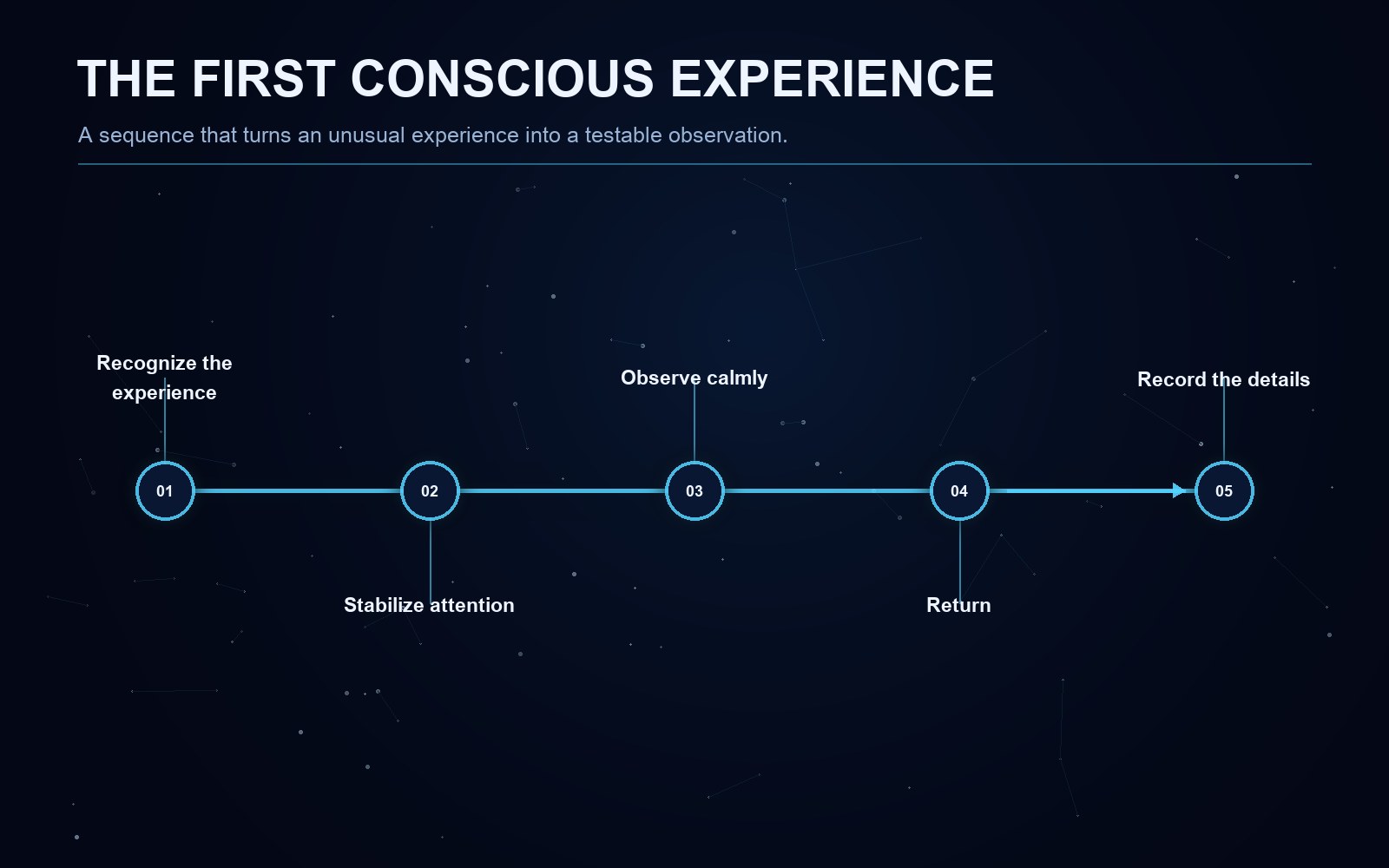
My First Intentional Preparation
The following evening, I made a simple plan. First I would use breathing and deep relaxation. Then I would visualize a place I knew well.
Late at night, in complete darkness and silence, I lay on the couch. For ten or fifteen minutes, I breathed calmly, remained still, and observed my body gradually relax. Then I began to imagine myself walking through a familiar place. I was not merely trying to produce a picture. I tried to feel that I was present there: the direction of movement, the distance, the position of objects around me.
Before long, vibrations appeared in my chest.
They resembled the shivering that comes after spending too long in cold water, except I was not cold. The sensation seemed to arise from within. It was not painful. In fact, it felt almost pleasant, like a gentle electrical massage moving through the body.
I decided the moment had come.
I got up from the couch, walked to the wall, placed my hand against it, and pressed.
The wall remained solid.
I looked back at the couch. My body was not there. No separation had taken place. I had felt the vibrations, assumed the transition was complete, and physically stood up.
It was a mistake, but a useful one.
I was relieved that I had begun by testing the wall instead of trying to fly. I lived on the fifth floor. That thought quickly restored both my seriousness and my sense of humor.
From that moment on, testing the state became essential. An unusual sensation does not necessarily mean a separation has occurred. The expectation of success can persuade a person too soon. I needed a simple way to distinguish preparation from the experience itself.
Rolling onto the Floor
I lay back down and repeated the breathing exercises.
After a while, the vibrations returned. This time they were accompanied by the familiar inner roar. I decided to try something different and imagined myself rolling out of my body, much as I believed I had during my first experience.
In the next instant, I landed on the floor beside the couch.
“Well, that failed again,” I thought.
The situation seemed so absurd that I laughed. From the outside, it must have looked ridiculous: a grown man lying on a couch in the middle of the night, trying to leave his body, only to roll onto the floor.
I stood up and turned around.
My body was lying on the couch.
In the same instant, I was back inside it.
This time the separation had happened intentionally. It was brief and completely undramatic. There were no grand visions, no voices, no symbols—only the floor beside the couch, a moment of laughter, and my own body in front of me.
That was precisely why the experience mattered so much. I had not expected that result and initially mistook it for failure. The test showed otherwise.
My earliest successes taught me something simple: real investigation rarely looks majestic. It is built from awkward attempts, mistaken conclusions, repetition, and unexpected details. What matters is not how impressive an event appears, but what you are able to notice within it.
Attention as an Instrument
That brief experience led me to another conclusion. Whenever I looked at or remembered my physical body, I returned to it.
If I wanted the state to continue, I needed to direct my attention away from the body and toward the surrounding space, movement, or a chosen destination.
Visualization took on a new meaning for me. I did not see it as inventing a fantasy. I used it to give attention a direction. When consciousness focuses on the body, the connection with physical perception becomes stronger and the experience ends. When attention is fully directed toward another place, continued movement becomes possible.
I began visualizing familiar places in as much detail as I could: the space, the distance, the arrangement of objects, the feeling of being present. Over time, I became convinced that the capacity to sustain an image and a direction of attention could be developed like any other skill.
Attention later became the central element of my practice. Not force. Not strain. Not the desire to obtain a result at any cost. Calm, steady attention.
It determined whether I recognized the moment of transition, whether I retained clarity, where my perception moved, and how long the experience lasted.
What My First Mistakes Taught Me
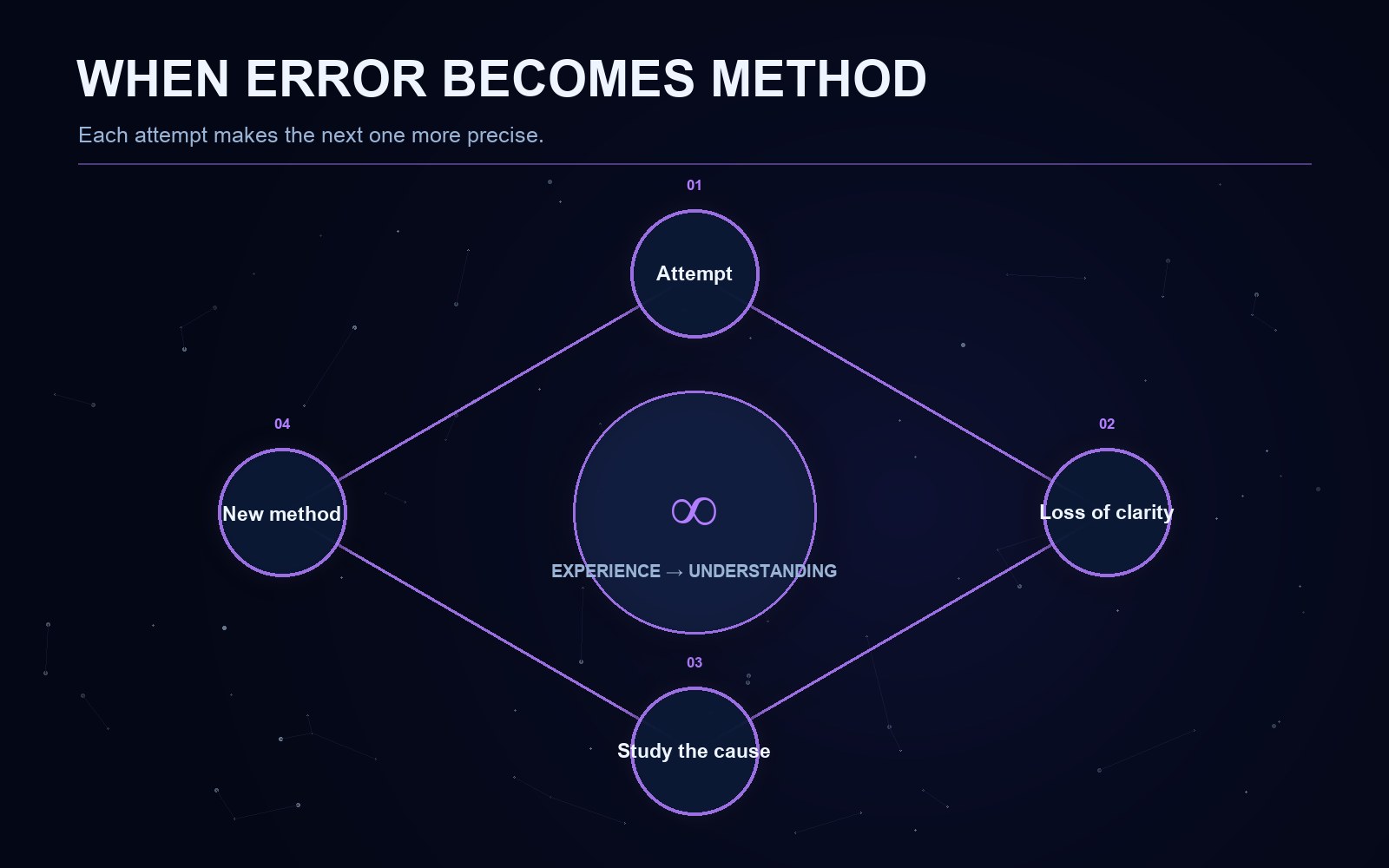
I made many mistakes at the beginning. Sometimes I fell asleep without noticing any change. Sometimes I mistook preparatory sensations for a completed separation. Sometimes I left the body but understood it too late. Sometimes I returned the instant I saw myself lying on the couch.
Every mistake refined the picture.
I learned that I could not rely on a single sign. Vibrations could occur without a separation, and a separation could happen without vibrations. A familiar-looking room was not proof of ordinary waking consciousness. I also learned not to let excitement take over completely, because a powerful emotional reaction quickly destabilized the state.
I learned to observe before explaining.
That distinction became the foundation of everything that followed. Explanation always comes after an event and inevitably reflects our existing beliefs. Observation comes first. The more precisely I remembered the sequence of sensations, actions, and consequences, the less dependent I became on other people’s ready-made interpretations.
I did not need permission to consider my experience meaningful. It had already changed my understanding of the human being and of reality. My task was different: to learn how to enter the state consciously, remain clear, and understand its structure step by step.
The Questions Became More Difficult
My first experiences lasted only a few minutes, but they opened a field that could not be explored in a single evening.
How could the state be extended? How could I move through space? Why did some thoughts help consciousness remain outside the body while others brought it back immediately? Why did a familiar room sometimes look almost ordinary while small details changed? How could I preserve a clear memory of everything I perceived? What was seeing the room while the physical eyes remained closed? And what connected that perceiving consciousness to the body?
I did not yet have answers. But these were no longer abstract philosophical questions. I had encountered them directly.
During the following year, I continued to practice, compare states, and learn through trial and error. I studied the vibrations, the moment of separation, the preservation of calm, and the direction of attention. Gradually, short accidental episodes began to become a more consistent experience.
As the possibilities expanded, so did the responsibility. The deeper I went, the more clearly I understood that a premature explanation could close the path to further knowledge. I could have adopted a religious interpretation, an esoteric system, or materialist dismissal—and stopped there. Instead, I chose to keep observing.
Why I Stopped Talking About It
My discoveries occupied almost all of my attention, and naturally I wanted to share them with family and friends.
Their reactions surprised me. People stared at me with wide eyes and asked whether I was all right. They knew nothing about such states, and I did not yet have the language to explain my experience calmly and clearly.
I saw that the conversation did not open a space for inquiry. It simply made people defend their familiar picture of reality.
So I chose silence.
I continued to practice and build my own understanding, but I told almost no one. For many years, this part of my life remained a secret. Only in 2020 did I begin to speak about it openly.
My silence did not mean that I doubted what I had experienced. It meant that I had not yet found a community capable of discussing such questions without fear, ridicule, or ready-made labels.
Today, I am creating that space myself.
From a Few Minutes to Twenty Years of Investigation
When I look back on those first attempts, I see more than extraordinary events. I see the beginning of a method.
First I noticed recurring signs. Then I tried to reproduce the conditions. I encountered failure. I formed a mistaken conclusion. I tested it. I obtained a different result. I compared it with what had happened before and formed the next question.
That is how a single experience became an investigation to which I have devoted twenty years.
At the time, I had no idea where those first separations would lead. I could not imagine the levels of reality I would encounter, the forms of consciousness I would meet, or how profoundly my understanding of the soul, life, and death would change.
But I had already understood the central truth: consciousness possesses capacities that people are rarely told about. Those capacities cannot be understood through speculation alone. They must be investigated—with attention, persistence, and the courage to follow the evidence of experience.
My hand passing through the wall was not a miracle demanding worship. It was a question.
And that question changed my life.
Continue the Story
In Phenomenon of Consciousness Outside the Body, I describe how the practice developed, the levels of reality I encountered, and the conclusions that emerged from twenty years of personal investigation.
Leave a Reply