
One of the first questions people ask about out-of-body experience is this: if the physical eyes are closed, what do we see with? If the body is lying in bed, what allows us to feel touch, movement, scent, or pain?
My experience shows that perception does not disappear after separation from the body. It changes. Sometimes sensations are weaker than physical ones, sometimes far more vivid, and sometimes a particular channel can be intensified or almost completely turned off by intention.
We do not perceive through physical organs
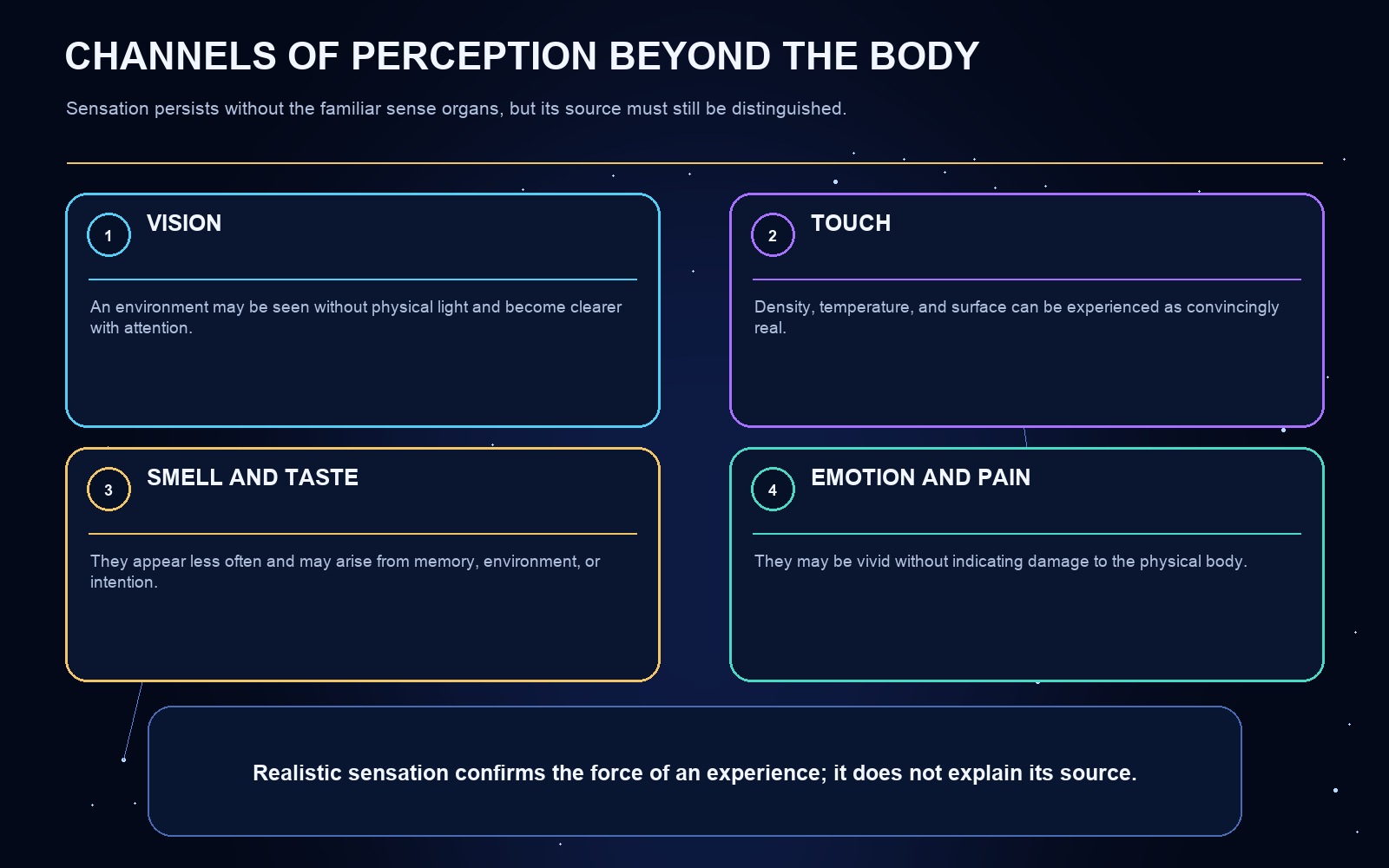
During an out-of-body experience, consciousness does not receive an image through the retina and optic nerve. Nevertheless, a person sees space, form, color, and movement.
The same is true of hearing and touch. I have heard speech, felt the surfaces of objects, and perceived movement while my physical body remained still.
This suggests that the sense organs do not create the experience itself. They transmit signals from the physical environment to the brain. Beyond the body, consciousness receives information in another way and translates it into familiar sensory forms.
Vision can function without light
In some experiences, I could see where there was no physical illumination. The space did not appear black. Objects were distinguishable as though lit from within, without a familiar source of light.
At times, the field of view became wider than normal. In other experiences, the image was unstable and required concentration. This is further evidence that out-of-body vision is not simply a copy of how the eyes work.
The quality of perception depends on the level of reality, the degree of awareness, and how actively the brain intervenes in translating the information.

Touch confirms the density of the environment
On the second energy level, walls, furniture, and the ground can feel solid. I could touch a surface and feel its texture and resistance. Yet the same barrier could stop being impassable when I changed my intention.
This is an unusual combination. The environment has properties of its own, but consciousness interacts with it far more directly than in physical reality.
Its density therefore cannot be understood as an exact copy of earthly matter.
Smell and taste appear less often
Smell is possible during an out-of-body experience, but in my practice it appeared less often than vision and motion. Taste is also not a constant part of the experience.
I associate this with the direction of attention. Vision dominates physical life, and the brain automatically translates most information into a visual scene. Smell and taste become active when they matter to the event or when consciousness deliberately attends to them.
Why emotion becomes stronger
Outside the body, emotion may be experienced as energy in its own right. Joy, love, anxiety, or fear does not merely color a thought; it fills the entire field of perception.
On higher levels, the feeling of closeness and recognition can be so powerful that ordinary language cannot convey it. On the second level, by contrast, fear can rapidly form a frightening image.
This is why emotional stability matters more than outward bravery. We must notice a feeling without allowing it to construct an entire reality around us at once.
What pain outside the body means
Pain is possible without physical injury, but it is different in nature.
Sometimes the brain translates a strong energetic influence into a familiar signal. Sometimes pain arises from expectation or fear. At other times, consciousness perceives the state of another being and experiences it as its own.
After returning, the physical body may be completely healthy even though the pain felt convincing during the experience. The sensation should not automatically be treated as proof that a nonphysical “body” has been injured.
At the same time, a physical symptom after waking should never be ignored. The condition of the organism must be checked first.
Sensations can be strengthened or weakened
Intention affects perception in an out-of-body state. If the scene is dim, concentrating on clarity may make it brighter. If an unpleasant sensation takes over attention, changing the purpose of the experience may reduce it.
This does not always happen immediately. The degree of control depends on awareness. Still, the relationship reveals how closely perception is tied to the direction of consciousness.
Realism does not explain the source
A sensation can be extraordinarily vivid and still belong to a mental construction. Conversely, an independent environment may seem unclear at first.
I therefore do not judge an experience only by its intensity. I look for the stability of the environment, unexpected details, repetition, and the possibility of later verification.
“It felt completely real” is an important statement, but the investigation begins with the next question: What produced that sensation?
In The Phenomenon of Consciousness Beyond the Body, I describe perception on different energy levels and specific episodes from my practice in greater depth.
Leave a Reply